

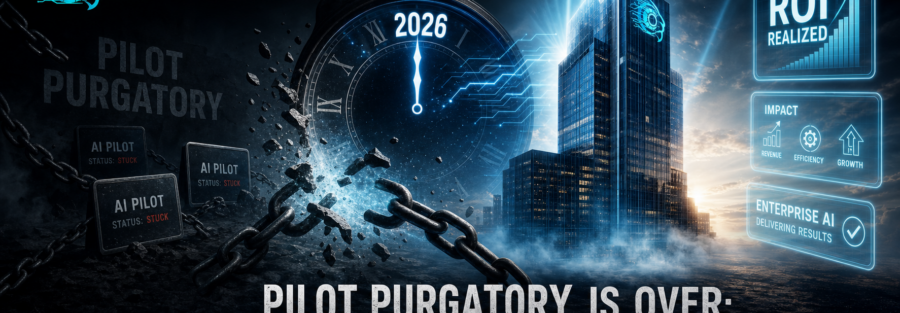
For the last two years, “we’re piloting AI” was an acceptable answer in almost any boardroom. In 2026, it isn’t anymore. Enterprises that once tolerated open-ended experimentation are now cutting pilots that drag on without measurable results, and redirecting budget toward the less flashy use cases that are actually easy to defend on a P&L. The organizations still stuck explaining a third year of “promising early results” are starting to look less like innovators and more like the ones who missed the shift.
The evidence that the shift is real
This isn’t a shift in sentiment it shows up directly in usage data. Enterprise AI platform providers report enterprise message volume growing roughly eightfold year-over-year, while API reasoning token consumption has increased by a factor of around 320. More telling than the growth rate is where that volume is concentrated: more than 9,000 organizations are now processing over 10 billion tokens each, and nearly 200 have crossed the 1 trillion token mark. That kind of consumption pattern doesn’t come from isolated proofs of concept. It comes from AI embedded in repeatable, production-grade workflows that people actually depend on every day.
The gap between those two groups production-scale adopters and organizations still running open-ended pilots is where 2026’s real competitive divide is forming.
What “ROI-first” actually looks like in practice
The organizations breaking out of pilot purgatory aren’t necessarily the ones with the biggest AI budgets. They’re the ones who stopped measuring AI initiatives by ambition and started measuring them by outcome. In practice, that means prioritizing the use cases that are boring enough to be easy to defend: automating compliance reporting, tightening supply-chain processes, strengthening cyber threat intelligence. None of these make for an exciting keynote slide. All of them produce a number a finance team can actually verify.
This marks a real departure from the “big bet” experimentation phase that defined 2023 through 2025, where flashy, high-visibility pilots often received disproportionate funding relative to their actual business impact. In 2026, that funding logic is reversing. Pilots that can’t produce a measurable outcome within a defined window are being cut rather than extended not because the technology stopped working, but because leadership stopped accepting ambiguity as a substitute for results.
The infrastructure question hiding behind the ROI question
Scaling from pilot to production isn’t just a budget decision it’s an operational one. Moving AI from a proof of concept into an integrated, enterprise-wide capability requires the unglamorous groundwork most pilots skip entirely: MLOps pipelines, real data engineering, and change management processes that account for how actual teams will use the tool day to day. Organizations that treated their pilot as a standalone experiment, disconnected from these foundations, are discovering that scaling it now means rebuilding most of the technical groundwork from scratch.
This is precisely why so many pilots stall in the same place: they proved the AI could work in a controlled setting, but nobody built the operational scaffolding needed to run it reliably at scale, with governed data flowing in and accountable outcomes flowing out.
Buy over build is becoming the default, not the exception
A related shift is changing how enterprises approach AI procurement itself. Rather than building custom models and infrastructure from the ground up, more organizations are defaulting to off-the-shelf AI capabilities an AI-powered CRM add-on, a SaaS analytics platform with AI built in, a pre-trained industry-specific model precisely because these options let a business stand up real capability faster and with meaningfully lower execution risk than a custom build. For most enterprises outside of AI-native industries, this is the more defensible path to production: faster time to measurable value, and less exposure to the operational gaps that stall custom pilots indefinitely.
What this means for leadership teams right now
Every open AI initiative needs a defined success metric, today. If a pilot has been running for more than two quarters without a number leadership can point to, it’s a strong candidate for the “cut” list forming across the industry this year not because it failed, but because it was never set up to prove success in the first place.
Prioritize the boring use cases before the exciting ones. Compliance reporting, supply-chain visibility, and threat intelligence aren’t glamorous, but they’re the use cases most likely to survive this year’s budget scrutiny, precisely because their outcomes are the easiest to measure and defend.
Treat infrastructure as part of the pilot, not a later phase. A pilot that can’t describe its own path to production the data pipeline, the governance model, the change management plan isn’t actually further along than a pilot that hasn’t started yet.
Default to buy, and reserve build for genuine differentiation. Off-the-shelf AI capability gets most enterprises to measurable value faster and with lower risk. Custom development is worth the investment when it protects a genuine competitive advantage not as the default starting point.
Turning this shift into an advantage
The organizations moving fastest out of pilot purgatory aren’t succeeding because they have better AI models than everyone else. They’re succeeding because they paired a clear-eyed view of which use cases actually justify investment with the operational discipline to scale them properly data pipelines, governance, and change management included, not bolted on after the fact.
That combination knowing where AI genuinely pays off, and knowing how to operationalize it without starting over is exactly where most enterprises need outside perspective the most.
Where VisionStratAI helps: Our AI consulting services help leadership teams identify which of their current AI initiatives are genuinely close to measurable ROI and which need to be rebuilt or retired, while our AI training programmes give the teams responsible for scaling AI the practical, role-specific skills that turn a promising pilot into a production capability.