
Your official AI rollout might be the smallest part of your organization’s AI exposure. While leadership teams debate platform choices and pilot programmes, employees are already using generative AI daily just not through the channels IT approved. This gap between sanctioned AI strategy and actual employee behaviour has a name: Shadow AI. And in 2026, it’s become one of the most expensive governance blind spots in enterprise technology.
What Shadow AI actually looks like
Shadow AI is the unsanctioned use of public or consumer generative AI tools ChatGPT, Copilot, or domain-specific models by employees working outside approved enterprise environments. It’s rarely malicious. Someone needs a summary written faster than the approved tool allows, or the sanctioned platform doesn’t cover their specific task, so they open a personal account and paste in what they’re working on. Multiply that by thousands of employees and hundreds of small daily decisions, and a pattern emerges that no governance policy accounted for.
The scale is larger than most leadership teams assume. Recent industry survey data shows nearly half of employees still use generative AI tools through personal accounts, even at organizations with an approved enterprise AI platform in place. Incidents involving sensitive data shared with AI tools have roughly doubled year over year, and the average enterprise now experiences well over 100 AI-related data exposure incidents per month.
Why it’s a governance problem, not a technology problem
It’s tempting to treat Shadow AI as an IT security issue to patch with better firewalls. The real picture is broader. Organizations with high levels of Shadow AI face measurably higher costs when something goes wrong: average breach costs run roughly $670,000 higher at organizations with extensive Shadow AI usage compared to those with low or no Shadow AI exposure. That gap isn’t about the AI tools themselves being unsafe it’s about the absence of visibility into where sensitive company data is actually flowing.
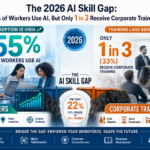
This connects directly to a wider pattern our research into the 2026 AI skill gap already surfaced: a majority of employees are already using generative AI tools at work, but only a minority have received any formal training on how to use them responsibly. Shadow AI is what happens in that gap. Employees aren’t waiting for permission they’re solving their own productivity problems with whatever tool is fastest, and few have been taught where the actual risk lines sit.
The compliance clock is already running
Shadow AI isn’t just a data security question anymore it’s a regulatory one. The EU AI Act’s enforcement timeline now requires documented AI governance for any system that materially affects decisions, safety, or compliance outcomes. For organizations already navigating obligations under GDPR, and depending on sector HIPAA, SOX, or PCI DSS, unmanaged AI usage creates a second, unmonitored layer of compliance exposure that sits entirely outside the systems built to satisfy regulators.
This is precisely where many organizations discover their AI governance framework was written for the tools they approved, not the tools employees are actually using.
The pattern behind failed AI initiatives
Shadow AI rarely shows up in isolation. It tends to appear alongside a broader symptom: AI initiatives that stall between pilot and production. Industry research on enterprise AI pilots consistently points to the same root causes unclear success metrics, governance built reactively after a problem surfaces rather than proactively, and a widening gap between what leadership assumes employees are doing with AI and what’s actually happening day to day.
Put simply: when employees don’t trust or fully understand the sanctioned AI tools available to them, they route around them. And every time that happens without visibility, the organization’s real AI risk profile diverges further from the one documented in its governance policy.
A practical starting point for closing the gap
Closing the Shadow AI gap doesn’t start with a ban bans on public AI tools rarely survive contact with a genuinely useful shortcut, and they push usage further underground rather than eliminating it. A more durable approach starts with three questions most organizations haven’t formally answered:
Where is Shadow AI actually happening? Before writing new policy, map which teams are using unapproved tools and why. The “why” usually points directly at a gap in the sanctioned toolset or a training gap, not a compliance failure by the employee.
What does the sanctioned alternative actually offer? If the approved platform is harder to use, slower, or narrower in scope than the free tool an employee already knows, adoption of the sanctioned option will stay low regardless of policy. Enablement has to compete on convenience, not just compliance.
Do employees understand what “safe” actually means in practice? Most Shadow AI usage isn’t reckless it’s uninformed. Employees pasting client data into a public chatbot usually don’t have a clear mental model of what happens to that data afterward. That’s a training gap, and it’s a closeable one.
Turning governance into enablement
The organizations narrowing this gap fastest aren’t the ones with the strictest policies they’re the ones that paired governance with genuinely useful, role-specific enablement. That means practical AI training that shows finance teams, HR teams, and marketing teams how to get real value from an approved tool without needing to reach for a personal account, combined with clear, non-punitive guidance on what data should never leave a sanctioned environment.
Shadow AI is ultimately a signal, not just a risk. It tells you exactly where your current AI strategy isn’t meeting real employee need. Organizations that treat it as a moment to close the gap rather than simply lock the door tend to end up with both better governance and higher genuine AI adoption than where they started.
Where VisionStratAI helps: Our AI training programmes are built around exactly this gap role-specific, hands-on training that gives teams a sanctioned way to get real AI value, paired with the governance clarity leadership needs. If you’re trying to understand where Shadow AI is showing up in your organization and what to do about it, our AI consulting team can help you map the gap before it becomes a line item in a breach report.