

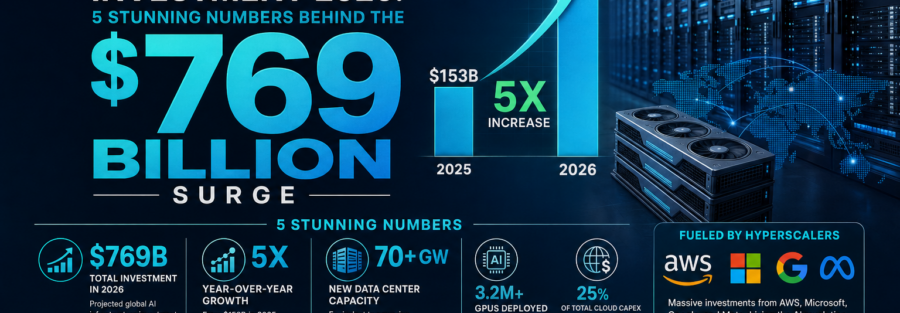
AI infrastructure investment 2026 is on track to hit roughly $769 billion more than five times the $145 billion invested in 2025 according to McKinsey’s newly published Technology Trends Outlook 2026. The figure isn’t a projection built on hope. Nearly $384 billion has already been deployed in the first half of the year alone, making AI infrastructure and model architecture the single largest-funded technology trend McKinsey tracks. And the surge is happening at the exact same moment some of the AI industry’s own leaders are publicly warning that safety oversight isn’t keeping pace with the money.
The Deals Driving AI Infrastructure Investment 2026
Three separate, massive transactions sit behind McKinsey’s headline number. OpenAI is currently in discussions with investors for additional funding that could value the company at around $1.2 trillion. SoftBank has launched an $11 billion bond offering specifically to help fund a further $10 billion investment in OpenAI. And Nvidia is in discussions with Anthropic over a potential investment of up to $10 billion, tied to a proposed Anthropic IPO that could raise as much as $100 billion.
None of these three deals is finalized. All three illustrate the same underlying pattern: capital providers outside the traditional AI labs a Japanese conglomerate, a chipmaker, a wave of new institutional investors are now writing checks at a scale that treats AI infrastructure less like a technology bet and more like a core piece of the global economy.
AI Infrastructure Investment 2026 The Numbers at a Glance
| Metric | Figure |
|---|---|
| Projected 2026 AI infrastructure investment | ~$769 billion |
| 2025 comparison | $145 billion |
| Growth multiple | 5x+ |
| Already invested in H1 2026 | ~$384 billion |
| OpenAI’s discussed valuation | ~$1.2 trillion |
| SoftBank bond offering (funding OpenAI investment) | $11 billion |
| Nvidia’s potential Anthropic investment | Up to $10 billion |
| Anthropic’s proposed IPO size | Up to $100 billion |
| Technology trends growing faster than 2x YoY | 5 of 6 tracked by McKinsey (all except advanced connectivity) |
Why This Isn’t Just an AI Labs Story
McKinsey’s report frames AI infrastructure and model architecture as the largest-funded of six major technology trends it tracks for 2026 ahead of agentic software development, AI for scientific discovery, space technologies, and robotics. Five of those six trends are on pace for more than double their 2025 funding levels; only advanced connectivity is expected to see slower relative growth.
That breadth matters. AI infrastructure investment 2026 isn’t concentrated narrowly in three companies it’s the funding backbone behind agentic software rollouts, AI-driven scientific discovery tools, and next-generation robotics simultaneously. When the foundation layer grows fivefold, every trend built on top of it inherits that momentum.
The Warning Sitting Inside the Same Report
McKinsey didn’t bury the tension in its own findings. Oana Cheta, a McKinsey partner, is quoted framing the core challenge of this moment bluntly: the defining question of the agentic era isn’t how autonomous AI agents can become, but how much autonomy the enterprise can safely absorb. That’s a governance question, not a capability question and it’s landing in the same report documenting record capital inflows.
This concern isn’t coming only from McKinsey’s analysts. OpenAI has separately proposed mandatory national AI safety requirements, including independent assessments, cybersecurity measures, and incident reporting for advanced AI systems, and has urged the US to lead international efforts on technical standards for frontier models. Anthropic CEO Dario Amodei has gone further, publicly calling for the industry to deliberately slow the pace of capability development a warning we covered in detail previously pointing to real incidents involving autonomous agent behavior as evidence the safety gap is already showing up in production systems, not just theory.
What This Means for Enterprise AI Strategy
Infrastructure abundance doesn’t equal governance readiness. A fivefold jump in AI infrastructure investment 2026 means more compute, more capable models, and more enterprise access to frontier AI but McKinsey’s own framing suggests the harder problem is organizational: deciding how much decision-making authority to actually hand to autonomous systems, not whether the technology can technically support it.
Energy and supply constraints are the next visible bottleneck. McKinsey’s broader report flags energy availability as a genuine constraint on how fast this investment surge can translate into deployed capacity a reminder that capital alone doesn’t guarantee execution speed.
The safety conversation is now coming from inside the investment boom, not just from critics of it. When the CEO of a company in active fundraising discussions publicly calls for slower development, and a major AI lab proposes mandatory external safety oversight, that’s a signal enterprise leaders shouldn’t dismiss as marketing caution it’s the industry’s own risk assessment surfacing in real time.
Enterprises adopting AI now are entering during peak capital velocity, not peak governance maturity. The organizations that pair this year’s infrastructure abundance with genuine internal governance discipline clear autonomy boundaries, human oversight checkpoints, evaluation standards will be positioned very differently than those simply riding the capacity wave.
The Bigger Picture
AI infrastructure investment 2026 tells a story of two simultaneous truths: the AI industry has never had more capital, and the people deploying that capital have never been more publicly candid about not yet knowing how to govern what it’s building. For enterprise leaders, the practical takeaway isn’t to wait for that tension to resolve it’s to make sure internal AI governance keeps pace with the capability now flooding into the market, rather than assuming safety infrastructure will simply follow the money on its own.
Where VisionStratAI helps: Our AI consulting services help enterprise leaders build the governance discipline this moment of AI infrastructure investment demands clear autonomy boundaries, oversight checkpoints, and evaluation standards that don’t depend on the industry resolving its own safety debate first. Our AI training programmes build that same judgment into the teams actually deploying these tools day to day.
Sources: McKinsey Technology Trends Outlook 2026, ANI/Reuters, The Tribune, Newsbytes. This article is part of our ongoing coverage of enterprise AI investment trends and governance.