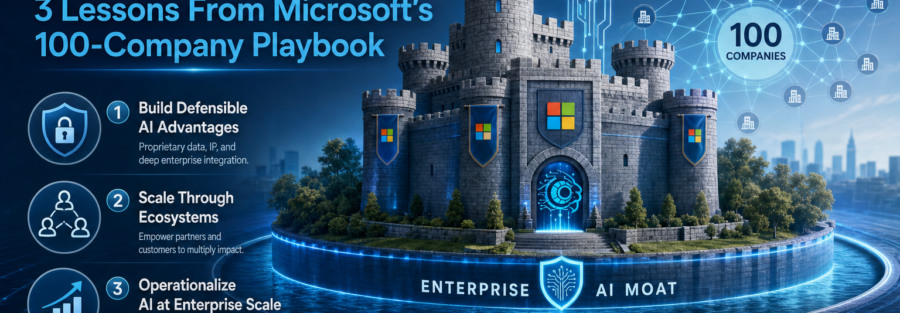
Enterprise AI moat is the question every leadership team is quietly wrestling with right now: if every competitor can access the same frontier models, where does real advantage actually come from? Microsoft just published its answer, and it isn’t the one most companies are betting on. After studying more than 100 internal AI transformation efforts, Microsoft’s new 44-page “Frontier Playbook” argues that the winning enterprise architecture puts proprietary evaluations, context, and learning loops above the foundation model itself and that many companies are already sitting on the raw material for this advantage without realizing it.
Why Microsoft Says “Don’t Start With the Agents”
The playbook’s core argument challenges how most organizations currently approach AI rollout. Microsoft says it made the same mistake early in its own transformation: treating AI like a standard technology rollout, measuring licenses and usage, and dropping new tools into workflows originally designed for humans. As Kathleen Hogan, Microsoft’s chief strategy and transformation officer, put it plainly access and usage did not necessarily produce business impact.
Instead, Microsoft recommends a sequence most companies skip: dismantle and redesign the underlying process first, establish a shared data foundation, decide explicitly which decisions stay human and which go to agents, and only then introduce the agents themselves. The company calls this “lean before agents.”
The Enterprise AI Moat Isn’t the Model It’s What Sits Above It
This is the playbook’s most consequential claim, and it directly answers the enterprise AI moat question. Microsoft’s diagram places security and governance at the top, evaluations and rubrics beneath that, then agent runtimes and tools, then enterprise context and orchestration and the foundation models sit at the very bottom, explicitly labeled “interchangeable.”
Microsoft breaks the real proprietary advantage into four categories: a company’s point of view about its market, its proprietary data and institutional knowledge, its particular sense of quality, and its risk boundaries for where agents can act autonomously. Wrapped together into what Microsoft calls a “hill-climbing machine,” these become continuous evaluations that improve AI systems against a company’s own standards standards that survive even when the underlying model gets swapped out.
The Numbers Behind the Claim
Microsoft’s own cloud supply-chain organization followed this exact pattern before deploying 111 purpose-built agents across planning, sourcing, fulfillment, and logistics. Rather than layering agents onto an existing process, a cross-functional team first simplified the workflow and built a single source of truth the agents could reason over.
The results, measured between April and August 2026: average planning cycle time dropped from roughly 10 business days to under 2.5 a reduction of as much as 75%. Demand-plan investigations that previously took 5 to 7 days now complete in hours, some in under 20 minutes. Microsoft is careful to note these figures reflect one specific 150-person effort, not a general benchmark but the architectural lesson holds regardless of the exact percentage: adding agents to a poorly designed process just automates the dysfunction faster.
From Copilots to “Human-Led, Agent-Operated” Teams
Microsoft’s playbook also lays out three levels of AI autonomy inside a company: Level 1, where employees work with AI assistants; Level 2, where agents join human teams and own specific tasks under direction; and Level 3, “human-led, agent-operated” workflows, where humans set direction while agents run entire processes and check in only when needed.
A nine-person Microsoft product team offers the most aggressive example. Built around specifications, evaluations, and shared context rather than traditional engineering process, the team delivered an initial product release in 35 days, with 18,600 commits and 9.3 million lines of code. Microsoft is explicit that this result reflects one dedicated project, not a companywide benchmark the operating model, not the raw numbers, is the actual takeaway.
What This Means for Your Enterprise AI Strategy
Audit your workflow before your agent roadmap. If a process hasn’t been redesigned to remove unnecessary approvals and handoffs, adding an agent on top of it risks automating existing inefficiency rather than fixing it.
Start building your own evaluation standards now, not after deployment. Notably, separate industry survey data cited in Microsoft’s own analysis found only 13% of enterprises fully trust automated evaluations today and that trust drops to just 4% among companies that already shipped an agent that passed internal evals and then failed in front of a customer. Proprietary evaluations built early are what close that gap.
Treat the foundation model as replaceable by design. If your competitive advantage depends on which model you’re using rather than the context, data, and governance layered around it, that advantage evaporates the moment a competitor switches to a comparable model which is exactly why the enterprise AI moat has to sit above the model, not inside it.
Measure business outcomes on the right timeline. Microsoft’s framework separates input changes (visible in 2-4 weeks) from workflow changes (1-3 months), performance effects (3-6 months), and business outcomes (6+ months) judging an AI deployment by adoption numbers alone misses where the real value actually lands.
The Bigger Picture Behind the Enterprise AI Moat
Microsoft’s playbook detailed by VentureBeat is also, unmistakably, a Microsoft document from a company that sells much of the infrastructure enterprises would use to build this architecture. That doesn’t make the underlying argument wrong. The first wave of generative AI had companies asking which model was smartest. The next phase is about rebuilding the enterprise around agents while deliberately keeping the model underneath replaceable. The scarce asset was never the model it’s the private evaluations, proprietary context, and governance systems that define what “good” means for your specific business.
Where VisionStratAI helps: Our AI consulting services help leadership teams design the evaluation, context, and governance layers that create a durable enterprise AI moat independent of which foundation model you use today or switch to tomorrow. Our AI training programmes build the institutional knowledge and workflow judgment that make this advantage actually durable across your teams.