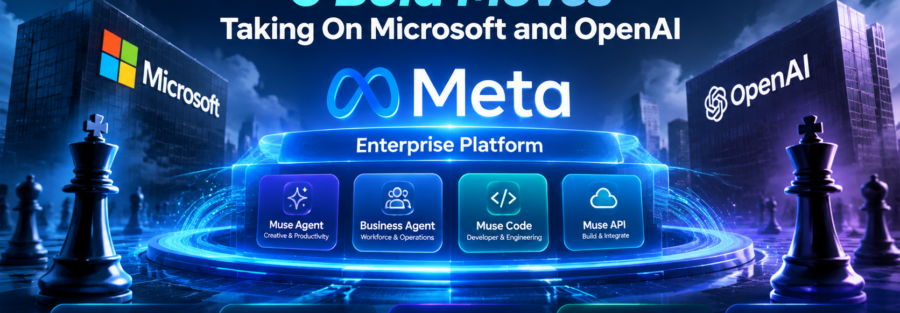
Meta Enterprise Platform just became Mark Zuckerberg’s direct answer to a question enterprise leaders have been asking all year: who actually wins the business AI market? On September 28, Meta announced the launch of Meta Enterprise Platform, a new business unit built to turn the company’s AI stack into products and services companies can deploy for their own operations. Zuckerberg framed it as the start of “the next major pillar” of Meta’s business, pulling in Chirantan “CJ” Desai poached to become Meta’s first Chief Enterprise Platform Officer to lead the charge directly against Microsoft Copilot and OpenAI’s enterprise push.
What Meta Enterprise Platform Actually Is
Meta Enterprise Platform combines four assets Zuckerberg says few competitors can match simultaneously: advanced foundation models, leading AI agents, large-scale infrastructure, and years of existing relationships with businesses through Meta’s advertising and commerce tools. The stated mission is turning that stack into deployable products companies can use to grow and transform their operations not just another chatbot wrapper, but infrastructure meant to sit inside real business workflows.
Desai, who reports directly to Zuckerberg, said the platform will focus on “turning its AI stack into products and services that companies can deploy for their own businesses,” with security and privacy built in from the outset a deliberate echo of the enterprise trust concerns that have slowed AI adoption across regulated industries.
Why Meta Enterprise Platform Matters for the Market Right Now
The enterprise AI race just gained a fourth serious contender. Microsoft has Copilot deeply embedded across Office and Azure. OpenAI has been racing to build enterprise relationships directly and through partners. Google has Gemini wired into Workspace. Meta Enterprise Platform signals that Meta isn’t content staying on the consumer and advertising side of AI it wants a seat at the same boardroom table.
Meta is leveraging a different kind of distribution advantage. Unlike pure AI labs building enterprise relationships from scratch, Meta already has deep commercial ties with businesses of every size through its advertising platform. Meta Enterprise Platform can potentially convert that existing commercial relationship into AI product adoption far faster than a company starting cold.
The superintelligence framing is deliberate positioning. Zuckerberg explicitly tied Meta Enterprise Platform to his broader “superintelligence” narrative, telling businesses this new capability will “create significant new opportunities for all people and businesses.” That’s a direct rhetorical challenge to how OpenAI and Anthropic have each framed their own enterprise ambitions.
What This Means for Enterprise AI Buyers
More competition should mean better terms. A genuine four-way contest between Meta, Microsoft, OpenAI, and Google for enterprise AI budgets typically translates into more aggressive pricing, faster feature releases, and more vendor flexibility for buyers who hold out rather than lock in early.
Vendor lock-in risk is rising, not falling. As each major platform races to embed itself deeper into enterprise workflows, switching costs between ecosystems are likely to grow. Organizations evaluating Meta Enterprise Platform, Copilot, or any competing stack should weigh portability and data ownership as seriously as feature comparisons.
Security and privacy claims need independent verification. Every major AI platform now markets itself as enterprise-safe and privacy-first. Meta’s own messaging echoes this directly. Enterprise buyers should treat these as starting points for due diligence, not substitutes for it.
The real test is execution, not announcement. Meta has a long history of bold enterprise and hardware ambitions that underdelivered relative to their launch framing. Meta Enterprise Platform enters a market where Microsoft and OpenAI already have working, revenue-generating enterprise products the gap between Meta’s announcement and a comparably mature offering is still unknown.
The Bigger Picture
Meta Enterprise Platform is less a single product launch than a signal: the biggest AI platforms no longer see enterprise software as someone else’s market to win. For businesses evaluating AI vendors, the practical takeaway isn’t to chase whichever platform makes the boldest announcement it’s to build an AI strategy resilient enough to benefit from this competition without becoming hostage to any single vendor’s roadmap.
Where VisionStratAI helps: Our AI consulting services help enterprise leaders evaluate competing AI platforms objectively separating genuine capability from launch-week positioning and design vendor strategies that avoid costly lock-in. Our AI training programmes build the internal expertise to make these platform decisions with confidence, regardless of which vendor your organization ultimately chooses.
Sources: Meta Newsroom. This article is part of our ongoing coverage of enterprise AI platform competition and strategy.