

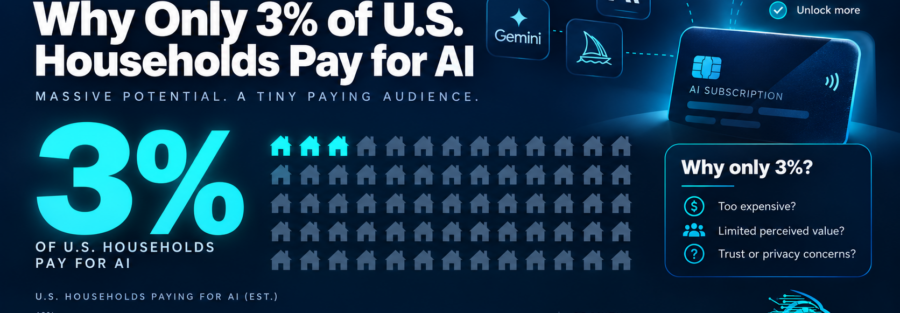
AI monetization is the hardest open question in artificial intelligence, and fresh bank data shows exactly why. According to Bank of America, only about 3% of its U.S. households were paying for AI services in early 2026, at a median of roughly $20 per month. PNC, using its own dataset, found that 2.2% of households paid for generative AI in May, at an average of about $31 per month.
Meanwhile, Pew Research Center reports that around half of American adults have already used an AI chatbot. Usage is mainstream, but payment is not.
For enterprise leaders planning AI monetization, that gap is the most useful number of the year. It tells you what happens when a technology spreads faster than the business model built around it.
What the Bank Data Reveals About AI Monetization
The analysis behind these figures rests on money actually leaving household accounts, not on survey answers. That makes it more reliable than asking people whether they would pay for AI.
Bank of America identifies AI payments across card and ACH transactions in its customer base. PNC follows a cohort of millions of households. Both acknowledge that their customers are not the full U.S. population, yet two independent sources landing in the same low-single-digit range makes the trend hard to dismiss.
Pew measures usage, not payment, so its percentages cannot be divided directly by the bank figures. Even so, the distance between “have tried it” and “pays for it” is enormous.
Key Facts
- Households paying for AI: about 3% (Bank of America), 2.2% (PNC)
- Typical monthly spend: roughly $20 median (BoA), about $31 average (PNC)
- Adults who have used an AI chatbot: about 49% (Pew)
- Growth signal: BoA reports paying households were already 38% above their 2024 average by February 2026
- Open-weight models on Vercel’s AI Gateway: from 7% of token volume in December 2025 to 56% by August 2026, but only 14% of spending
- Potential U.S. consumer AI market: up to $75 billion a year, according to Bank of America
Is the Glass 97% Empty or 97% Full?
The answer depends on who is holding the glass.
For an AI lab selling one more $20 subscription, 97% of households saying no looks like a wall. Freemium taught hundreds of millions of people to use AI, but it has been far less effective at turning that habit into a permanent monthly bill. Most people love AI. They simply like free AI more.
For a company that already owns the customer relationship, the billing and the identity, the same number looks like open space. There is also an optimistic reading of the trend: paying households were already well above their 2024 level by February, so this may be an early curve, similar to broadband in the late 1990s.
Who pays for AI today?
Paid AI behaves like a premium product. Bank of America finds the highest penetration among households earning more than $125,000, and roughly 5% of Gen Z households pay compared with about 2% of Gen X.
PNC sees an even sharper split: 4.1% of higher-income households pay, versus 2% of middle-income and less than 1% of lower-income households. Economically, AI payment still looks like specialist software, while AI behavior increasingly looks like infrastructure.
Why Falling Model Costs Change AI Monetization
A second trend sits underneath the first: intelligence itself is becoming cheaper, fast.
Vercel AI Gateway data offers a window into production traffic. Open-weight models went from 7% of token volume in December 2025 to 56% by August 2026, overtaking closed models for the first time, while accounting for only 14% of spending. Average token prices across the gateway fell another 23.2% in August alone. The same data shows high-volume production workloads routing across more than 30 models on average.
This is developer and enterprise traffic, not household traffic, so it should not be extrapolated blindly. But the signal for AI monetization is clear: huge amounts of inference are moving toward cheaper intelligence.
If every request goes to the most expensive model, the economics resemble using a sports car for a one-mile grocery run. Sometimes you need it. Most of the time you need transportation.
5 AI Monetization Lessons for Enterprise Leaders
1. Adoption is not revenue
High usage inside a company does not prove value. Strong AI monetization starts with value, so tie every AI deployment to a measurable outcome such as hours saved, tickets deflected or revenue retained. Our AI consulting work starts exactly there, with AI roadmap and use-case prioritization.
2. Sell outcomes, not model access
Consumers do not really want models. They want answers and outcomes, and enterprise buyers are heading the same way. AI monetization built on a model brand alone will struggle once cheaper alternatives deliver the same result.
3. Stay model-agnostic
With models commoditizing quickly, contracts and architectures locked to one provider can age badly. Design for routing across several models and review the mix regularly.
4. Own the orchestration layer
If models become interchangeable, value accumulates in the system that understands the customer, routes each request, manages identity and privacy, and handles billing. Model fragmentation can raise the value of that abstraction layer.
5. Start where willingness to pay is proven
The household data shows that higher-income and younger users pay first. In the enterprise, the equivalent is to begin with high-value, measurable use cases and expand from there, instead of chasing universal rollout on day one.
Where Telcos and Distribution-Rich Players Fit
The newsletter analysis behind this article argues that telecom operators have a bigger AI monetization opportunity than simply reselling subscriptions. They already hold the household relationship, the monthly bill, connectivity, identity, support and security services.
Bundling is the obvious first move, and it is already happening. Verizon offers six months of Google AI Pro, then bills the perk at $10 per month. Telefónica has offered a year of Perplexity Pro in Spain, Brazil, the UK and Colombia. Deutsche Telekom includes 18 months of Perplexity Pro with its AI Phone.
But handing out someone else’s subscription is distribution, not ownership of the AI relationship. A stronger model is one household subscription, one identity and one bill, with the platform choosing the right model behind the scenes. Apple, Google, Microsoft, Amazon and the AI labs want that layer too, so nothing is guaranteed.
Operators exploring this path can start with our AI training for telecom companies.
AI Monetization Checklist
Use this short list before approving your next AI budget:
- Which measurable outcome does this AI initiative improve?
- Could a cheaper or open-weight model deliver the same result?
- Is our architecture able to switch or route between models?
- Do we price on outcomes, or only on seats and access?
- Who owns the customer relationship, the data and the billing?
FAQ: AI Monetization and Paid AI Adoption
What percentage of households pay for AI?
Bank of America found about 3% of its U.S. households were paying for AI in early 2026, and PNC found 2.2% in May. Both datasets are based on actual payments, not surveys.
Why does AI usage not turn into revenue?
Freemium models taught people to use AI at no cost, and many consumers do not see a reason to add another recurring $20 subscription. Paid adoption is also concentrated among higher-income and younger households.
Does this matter for enterprise AI?
Yes. The same pressure applies to enterprise buyers: cheaper models, many providers and a growing demand for outcome-based pricing. Companies should tie AI spending to measurable results and keep their architecture flexible.
The Takeaway
When it comes to AI monetization, the data is clear. If you are building an AI business, do not assume usage will convert into revenue on its own. If you are buying AI, insist on pricing tied to outcomes and keep your stack model-agnostic. And if you already own a customer relationship, 3% is less a warning than an invitation.
Next step: explore our industry-specific AI training, read more analysis on the VisionStratAI blog, learn what we do, or talk to an AI expert about your own AI monetization plan.
Sources: Bank of America and PNC household payment data, Pew Research and Vercel AI Gateway figures, as reported in Sebastian Barros’ newsletter of October 7, 2026. Figures are cited as reported; verify against the original reports before quoting.
Originally published on VisionStratAI.