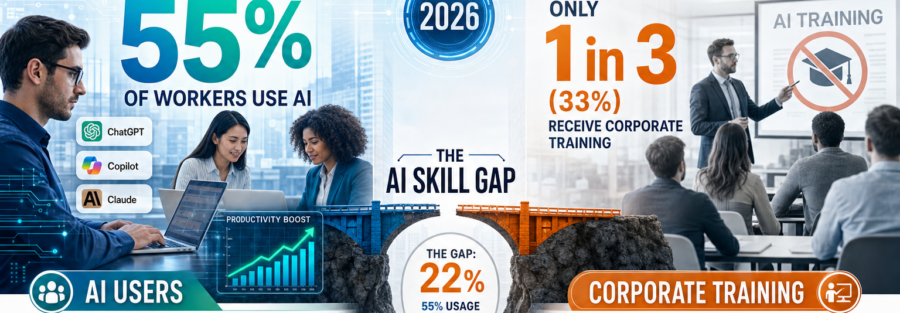
Artificial intelligence has embedded itself into daily work faster than most organizations have managed to prepare for it. In 2026, a majority of employees are already using generative AI tools to write, analyse, or automate parts of their job. But behind this rapid adoption lies an uncomfortable truth: training hasn’t kept pace. That paradox widespread AI usage paired with deeply uneven access to training is what this article breaks down. The 2026 AI Skill Gap: 55% of Workers Use AI, raising questions about the future of corporate training.
AI adoption is accelerating everywhere
The 2026 AI Skill Gap: 55% of Workers Use AI will require innovative solutions to bridge the gap between usage and training.
The 2026 AI Skill Gap: 55% of Workers Use AI highlights the urgent need for organisations to adapt their training methods.
Recent data confirms a clear trend. According to ManpowerGroup’s 2026 Global Talent Barometer, regular AI usage among workers jumped 13 points year-over-year to reach 45% globally, even as worker confidence in using the technology dropped sharply over the same period. In the US, research from Jobs for the Future shows an even steeper climb, with AI use in the workplace rising from 8% to 35% in just over a year.
Leadership sentiment tells a similar story. Most executives now actively encourage their teams to use AI, and the majority report that their teams already do so regularly. AI is no longer an experimental initiative confined to technical teams it has spread across nearly every function of the modern enterprise.
But training hasn’t caught up
This is where the gap opens. Multiple studies converge on the same finding: only around a third of employees receive meaningful AI training from their employer. Docebo’s 2026 report on enterprise AI readiness found that a large share of employees say the training they’ve received doesn’t actually help them use AI in their role, and a meaningful portion report receiving no AI training at all. General Assembly’s research adds another layer: while most leaders have attended some form of AI training, less than half of companies offer a program specifically designed for leadership roles.
This lack of structured training shows up as a broader confidence gap. While nearly all workers feel capable in their current role, a growing share fear that automation could threaten their job in the near term a fear fueled in large part by the absence of real support and upskilling.
Why this gap is a strategic risk
This mismatch between adoption and training isn’t a minor detail. Economic analyses put the potential global cost of this skills shortfall in the trillions of dollars, driven by delayed products, missed revenue, and eroded competitiveness. Among enterprises themselves, a lack of employee skills is consistently cited as the single biggest barrier to genuine AI-driven transformation ahead of budget or technology constraints.
In other words: companies are pouring money into tools while underinvesting in the people meant to use them. A tool that goes underused for lack of training isn’t a productivity gain it’s a cost with no return.
Closing the gap
Organizations looking to close this divide between adoption and competence have several concrete levers available:
- Build a continuous learning path, rather than one-off sessions disconnected from how people actually work.
- Tailor training by role and seniority, from frontline staff to leadership, since needs differ significantly across levels.
- Track real AI usage in workflows, not just self-reported adoption rates.
- Treat the human side of change as seriously as the technical side, since uncertainty among employees is a management issue as much as a training one.
This is exactly the kind of strategic support — usage diagnostics, tailored training roadmaps, and transformation guidance that VisionStratAI provides to organizations looking to turn AI adoption into a lasting competitive advantage, rather than a headline without substance.
Conclusion
2026 marks a turning point: AI is no longer a question of access, but of competence. The companies that manage to close this training gap will build a durable lead over those that simply roll out tools without supporting their people. To explore AI transformation strategies tailored to your organization, check out VisionStratAI’s services.
Sources: ManpowerGroup Global Talent Barometer 2026, Docebo “The AI Readiness Gap” 2026, General Assembly, Jobs for the Future, IDC, Deloitte State of AI in the Enterprise 2026.