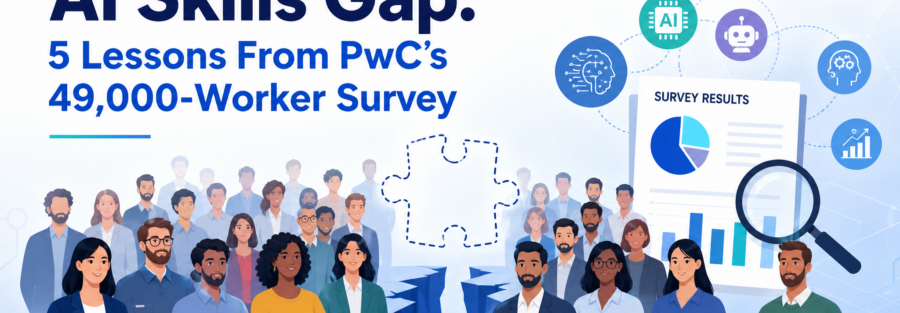
The AI skills gap is widening just as AI use accelerates. PwC’s 2026 Global Workforce Hopes and Fears Survey, which polled 49,364 workers across 48 countries and territories, found that AI use at work rose about 10 points in a year, while the share of workers who say they can get the training they need fell from 59% to roughly half. For any company rolling out AI tools, that is a warning: access to the technology is spreading faster than the skills to use it well.
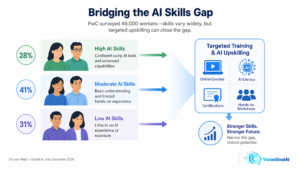
What PwC Found About the AI Skills Gap
According to coverage by People Matters and The Next Web, PwC segmented workers into four groups based on AI proficiency and how scarce their skills are. Front-runners (14%) have scarce skills and strong AI capability and benefit most. Indispensables (11%) have highly valued skills but lower AI maturity. The largest group, the engine room (56%), has less scarce skills and limited AI progression.
Employees who use AI daily report stronger confidence and a better career outlook than infrequent users. The risk PwC points to is a two-speed workforce: those already using AI keep gaining, while the majority is left behind.
AI Skills Gap Key Facts at a Glance
| Detail | Fact |
|---|---|
| PwC survey size | 49,364 workers in 48 countries and territories (May and June 2026) |
| AI use at work | Up about 10 points in a year; nearly two-thirds used AI in the past year |
| Access to needed training | About half of workers, down from 59% |
| Workforce segments | Front-runners 14%, indispensables 11%, engine room 56% |
| Leaders vs training (Zapier, 542 US executives) | 77% say AI skills are urgent; 78% report at least one significant barrier; only 7% put L&D in charge |
| Employees vs readiness (Skillsoft, via IT Brief) | 86% use AI at work, only 24% feel fully equipped |
| Trained vs untrained (Indeed and YouGov) | 77% of AI natives say training was adequate, versus 15% of workers yet to integrate AI |
Why the AI Skills Gap Hurts Results
Separate surveys point in the same direction. The Zapier survey of 542 executives shows that leaders see the urgency but rarely assign clear ownership, with only 7% putting learning and development in charge of fixing it. The Skillsoft findings highlight a lack of formal skills assessment, and nearly six in ten employees cite lack of time as the main obstacle to learning.
The Indeed and YouGov survey adds the sharpest contrast: workers who already use AI heavily mostly feel well trained, while those who have not yet integrated it rarely do. Training reaches the people who need it least.
What This Means for Enterprise AI Strategy
Train the engine room, not only the front-runners. The largest group of employees is the one least likely to get help. Programmes built only for technical or enthusiastic staff leave most of the workforce behind.
Assess skills before choosing courses. Without a baseline, training is guesswork. A short skills assessment shows who needs the basics and who needs role-specific depth.
Give people protected time. When lack of time is the main obstacle, a course catalogue does not help. Build learning into working hours and into real tasks.
Assign a clear owner. Executives call the gap urgent, yet few name who fixes it. Pick one accountable leader and link their goals to measurable adoption.
Tie training to real workflows. Our piece on moving AI from pilot to scale shows that tools only pay off when processes change with them, and our analysis of AI agents ROI explains how to measure the result.
The Bigger Picture
The AI skills gap is not only an HR issue. It decides whether AI investments produce returns or sit unused. Companies that give every employee a practical path to using AI safely and effectively will keep their AI-savvy talent and lift the rest of the workforce, instead of widening the divide between them.
Where VisionStratAI helps: Our AI training programmes build practical AI skills for managers and teams, with tracks by industry and job, including AI training for HR teams and AI training for telecom companies. Our AI consulting services help you assess current skills and design a rollout that fits your organisation.