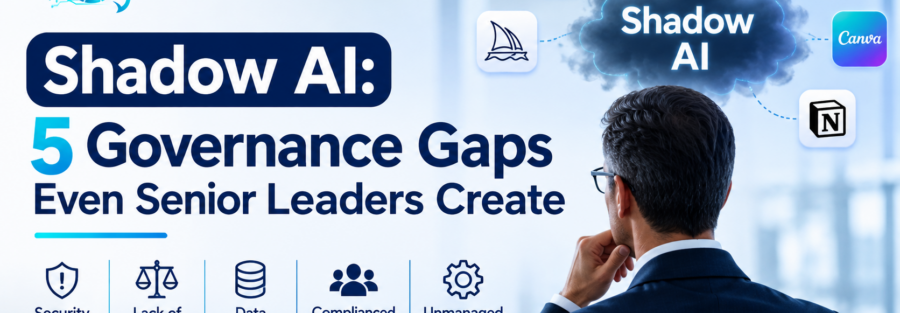
Shadow AI, the use of AI tools without employer approval or oversight, is no longer a fringe habit. Verizon’s 2026 Data Breach Investigations Report, as summarised by Nasstar, records employee use of AI tools on work devices rising from 15% to 45% in one year, and several 2026 surveys find that roughly half of employees use tools their company has not sanctioned. The uncomfortable detail is who does it most: senior decision-makers, not junior staff. For organisations building an AI strategy, shadow AI is a governance problem first and a technology problem second.
What the 2026 Surveys Say About Shadow AI
BlackFog’s survey of 2,000 employees in the UK and US found that 86% use AI tools at least weekly for work, and that among those using unapproved tools, 58% rely on free versions that often lack enterprise-grade security and privacy protections. One-third of employees reported sharing research or data sets through such tools, and 51% had connected AI tools to other work systems without IT approval.
TrustedTech and Censuswide surveyed 2,001 UK and US employees in March 2026. They found that 48% use unapproved AI tools, and that senior decision-makers are more than twice as likely to do so as the people they manage: 65% versus 31%, rising to 73% at C-suite level. Several of these surveys are commissioned by security vendors, so treat the exact percentages as indicators rather than precise measurements.
Shadow AI Key Facts at a Glance
| Detail | Fact |
|---|---|
| Employee AI use on work devices | 15% to 45% in one year (Verizon 2026 DBIR, as summarised by Nasstar) |
| Employees using AI weekly for work | 86% (BlackFog, 2,000 UK and US employees) |
| Unapproved-tool users relying on free versions | 58% (BlackFog) |
| Employees sharing research or data sets via unsanctioned tools | One-third (BlackFog) |
| AI tools connected to work systems without IT approval | 51% of employees (BlackFog) |
| Employees using unapproved tools | 48% (TrustedTech and Censuswide, March 2026) |
| Senior decision-makers vs staff | 65% versus 31%; C-suite 73% (TrustedTech and Censuswide) |
| AI users with no formal training | 31% (Lenovo Work Reborn 2026, 6,000 employees) |
Why Shadow AI Grows
People turn to unapproved tools for simple reasons. According to the TrustedTech research, the top reasons given by decision-makers were limited access to approved tools and finding unapproved tools more efficient. In other words, shadow AI is rarely malicious. It is ambitious people trying to hit targets with the best tool they can find.
Banning tools tends to make this worse. Reporting from Kiteworks argues that bans push usage into less visible channels, and that relying on employees to self-report tools is a weak control, especially when many have received no formal AI training.
What This Means for Enterprise AI Strategy
Give people approved tools that are genuinely competitive. When 28% of decision-makers say unapproved tools are simply more efficient, the gap is in the sanctioned offer. A tool nobody wants to use does not reduce risk.
Treat leaders as the first audience. If senior staff bypass policy more often than their teams, a policy aimed only at junior employees will not work. Executive behaviour sets the real standard.
Classify data before you write rules. Employees need a simple answer to a daily question: what can I paste into an AI tool? Define public, internal and confidential categories, and match each to approved tools.
Train before you restrict. With 31% of AI users reporting no formal training, a rule without training only pushes use underground. Our piece on moving AI from pilot to scale shows why adoption needs support, not just permission.
Measure and review. Track which tools are in use, which data categories are involved and how many approved alternatives exist, then review the policy every quarter.
The Bigger Picture
Shadow AI is a signal that demand for AI is running ahead of supply inside organisations. Companies that respond with approved tools, clear data rules and practical training turn that demand into advantage. Companies that respond only with bans keep the risk and lose the productivity. This is also why measuring results matters, a theme we cover in our article on outcome-based AI pricing.
Where VisionStratAI helps: Our AI consulting services help organisations design AI governance, data classification and approved tool lists that people actually use. Our AI training programmes give managers and teams practical rules for safe AI use, including AI training for HR teams who often write the policy.