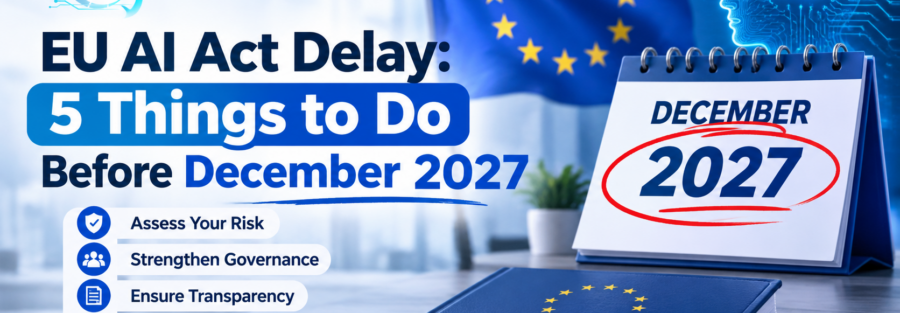
The EU AI Act delay is now confirmed: the Digital Omnibus on AI moves the date for stand-alone high-risk AI systems from 2 August 2026 to 2 December 2027, and for high-risk AI embedded in regulated products to 2 August 2028. According to a legal summary by Hogan Lovells, the delay gives businesses extra time but underlines that preparation should already be underway. For any company that sells AI or AI-enabled products into the EU, the lesson is that a later deadline is not a reason to pause.
How the EU AI Act Delay Unfolded
The European Commission tabled the Digital Omnibus on AI on 19 November 2025, after concerns that the harmonised technical standards needed for compliance would not be ready in time. Parliament and Council reached a provisional agreement on 7 May 2026. According to a CASRAI explainer, Parliament endorsed it on 16 June 2026 and the Council gave final approval on 29 June 2026.
Reporting by EU Perspectives says Parliament adopted the package with 423 votes in favour, 57 against and 174 abstentions, with digital-rights groups urging rejection because the postponement lets potentially harmful systems stay on the market longer. The Commission framed the change as targeted: the core risk-based structure of the Act is unchanged.
EU AI Act Delay Key Facts at a Glance
| Detail | Fact |
|---|---|
| Proposal | Digital Omnibus on AI, tabled 19 November 2025 |
| Provisional agreement | 7 May 2026 |
| Final approvals | Parliament 16 June 2026; Council 29 June 2026 (per CASRAI) |
| Stand-alone high-risk systems (Annex III) | Moved from 2 August 2026 to 2 December 2027 |
| High-risk AI in regulated products (Annex I) | Moved to 2 August 2028 |
| Unchanged | Risk-based structure, prohibited practices and general-purpose AI model rules |
| Parliament vote on the package | 423 for, 57 against, 174 abstentions (EU Perspectives) |
| Criticism | Digital-rights groups say the delay weakens protection at a critical moment |
What the EU AI Act Delay Does Not Change
Prohibited practices and the rules for general-purpose AI models remain in place. The delay touches only the high-risk obligations. Therefore, companies cannot treat the new date as a general pause on AI compliance.
Moreover, one analysis notes that the practical effect is headroom, not relief. Organisations that paused work in anticipation of the delay now have a defined runway of roughly seventeen months from the June 2026 vote, which is shorter than many expected.
What This Means for Enterprise AI Strategy
Build an inventory of your AI systems now. You cannot classify risk for systems you have not listed. A simple register of tools, owners, purposes and data sources is the foundation for everything else.
Classify each system by risk. Identify which systems could fall under the high-risk categories, such as those used in hiring, education or credit decisions, and which are low-risk productivity tools.
Assign ownership and oversight. High-risk rules expect human oversight, documentation and monitoring. Decide now who owns each of these for every system, before the date arrives.
Use the extra time for governance, not postponement. Policies on data quality, logging and vendor contracts take months to build. Our analysis of shadow AI shows how unapproved tools undermine exactly these controls.
Ask vendors for their compliance plans. If you buy AI rather than build it, request documentation and a timeline from each supplier, and keep contracts flexible. Our article on buying versus building AI capability covers that decision.
The Bigger Picture
The EU AI Act delay reflects a gap between regulatory ambition and the standards, authorities and tools needed to apply it. For companies outside the EU, including those in North Africa that serve European customers or partners, the rules can still apply through the products and services they supply. A prepared organisation treats the extra months as time to build governance that also supports trust, procurement and risk management.
Where VisionStratAI helps: Our AI consulting services help organisations build an AI inventory, classify risk and set up governance that fits their size and sector. Our AI training programmes give leaders and teams the practical knowledge to apply these rules, and our AI training for finance teams covers risk-sensitive use cases.