


AI CDN infrastructure is quietly rewriting a rule that held for more than a century: a movie has been a finished product before anyone watches it every frame already exists, baked and immutable. Generative AI is quietly dismantling that assumption. A recent conversation between telecom analyst Sebastian Barros and Runway’s founder surfaced a shift that goes well beyond better video models: the industry is moving from streaming content that’s already been produced to generating it while people are watching. That distinction sounds technical. Its implications reach into enterprise infrastructure spend, advertising economics, and compute strategy for any business touching media, content, or customer-facing AI experiences.
From Finished Product to Running Software
Games have never worked like movies. A game studio ships an engine, a world, characters, rules, and assets, then renders what actually appears on screen based on what the player does in real time. Generative AI is starting to pull film toward that same model a future “movie” may ship as a story world and a set of constraints rather than one fixed sequence of scenes, with parts of the experience generated only after a viewer presses play.
Once that happens, the idea of a final cut starts to dissolve. Content can be versioned, updated, and extended the way software is a studio could launch a title and add new characters or storylines months later, without a traditional sequel production cycle. A successful franchise stops looking like a series of releases every few years and starts resembling a persistent platform that keeps evolving.
Why AI CDN Infrastructure Changes the Compression Layer
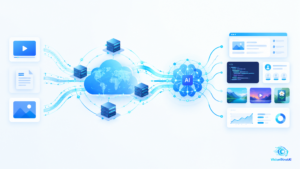
This shift changes what the network actually has to carry. Today, a streaming service sends finished pixels because the device on the receiving end can’t recreate the content itself. If televisions, consoles, and phones become powerful enough to render generated scenes locally, the sender may only need to transmit models, scene state, and instructions letting the device produce the final image. Generation starts performing part of the job compression does today, but operating at a fundamentally higher semantic level: potentially far more content delivered using meaningfully fewer transmitted bits per hour of experience.
Personalization initially makes traditional caching less efficient, since fewer viewers request exactly the same file. But caching doesn’t disappear what gets cached changes. Models, character assets, textures, and common scene components can still be stored close to viewers, and platforms can pre-generate likely story branches before anyone requests them, reserving expensive live inference for genuinely unexpected viewer choices. The traditional cache-hit ratio starts evolving into something closer to a predicted-branch-hit ratio.
Where the Rendering Actually Happens
The most efficient place to generate content isn’t a data center it’s the television, console, or phone already sitting in front of the viewer, where the silicon is already paid for and personal data can stay local. That means the opportunity for infrastructure providers may hinge as much on the chip roadmaps of Apple, Qualcomm, Nvidia, Samsung, and Sony as on anything a network operator builds.
A countervailing force pulls the other way, though: studios may resist placing valuable character models and world weights directly on millions of consumer devices where they could be copied or extracted. IP protection considerations could keep meaningful parts of generation inside more controlled infrastructure even once consumer devices are technically capable of running it creating a real opening for metro-level compute sitting between the device and large, distant AI factories: handling experiences too demanding for consumer hardware, but too interactive for a remote data center. Infrastructure providers betting heavily on this middle layer should treat it as a transitional window, not a permanent moat if consumer silicon advances quickly, today’s infrastructure investment can become tomorrow’s stranded asset.
The Economics Shift From Bits to Watts
Streaming’s peak demand has always been primarily a bandwidth event. Generated content adds an entirely different variable: electricity. Millions of people consuming AI-generated experiences simultaneously creates synchronized demand for GPU capacity, cooling, and power concentrated into just a few evening hours, the same way today’s streaming peaks are. That same infrastructure needs other work during off-peak hours: enterprise inference during business hours, and overnight compute pre-generating the scenes and story branches most likely to be requested the next day.
This reframes a negotiation that infrastructure providers have run for over a decade. The original CDN relationship worked because it saved money on both sides a streaming platform got closer to its viewers, while the network operator avoided repeatedly hauling identical video across its backbone. Generation changes that math. A rack of GPUs can draw enormous electricity and cooling capacity while mainly reducing the AI platform’s own compute bill rather than the network’s transit costs. Providers hosting this infrastructure shouldn’t assume the old free-hosting arrangement transfers automatically if an AI company wants power, floor space, cooling, and a location close to millions of end users, that increasingly resembles a data-center transaction, not a traditional bandwidth-hosting one.
What This Means for Enterprise AI and Infrastructure Strategy
Content-adjacent businesses should model compute and power costs now, not after adoption scales. Any organization building AI-generated media, personalized content experiences, or real-time generative products needs infrastructure cost models that account for GPU-driven electricity demand concentrated into narrow usage windows a materially different cost structure than traditional content delivery.
Infrastructure investment decisions should account for consumer hardware trajectories. Betting heavily on data-center-side generation infrastructure carries real risk if on-device AI capability driven by chipmakers’ own roadmaps, not infrastructure providers’ advances faster than expected.
Advertising and personalization economics are shifting toward programmatic generation. As scenes themselves become generated rather than fixed, products, placements, and even dialogue can be tailored to individual viewers in real time raising new questions around rights, consent, and regional content rules that need to be resolved at the point of generation, not after the fact.
The commercially scarce resource is shifting from bandwidth to power. Organizations that have spent years optimizing around the cost of data transmission need a parallel strategy for the cost of compute and electricity a fundamentally different constraint with a different cost curve.
The Bigger Picture
The rise of AI CDN infrastructure doesn’t just change what a studio produces it changes what counts as infrastructure, where value accumulates, and what gets scarce. Organizations treating this purely as a content or creative question are missing the more consequential one: who controls where generation happens, and who’s positioned to profit as that computation becomes the new unit of media delivery.
Where VisionStratAI helps: Our AI consulting services help organizations model the infrastructure, compute, and governance implications of generative AI before committing capital to a specific architecture. Our AI training programmes build the strategic fluency your teams need to evaluate where content, compute, and infrastructure decisions intersect.
Source: Analysis adapted from Sebastian Barros’ newsletter, “AI CDN: What Happens When Movies Become Software” (October 5, 2026). This article is part of our ongoing coverage of generative AI infrastructure and enterprise strategy.