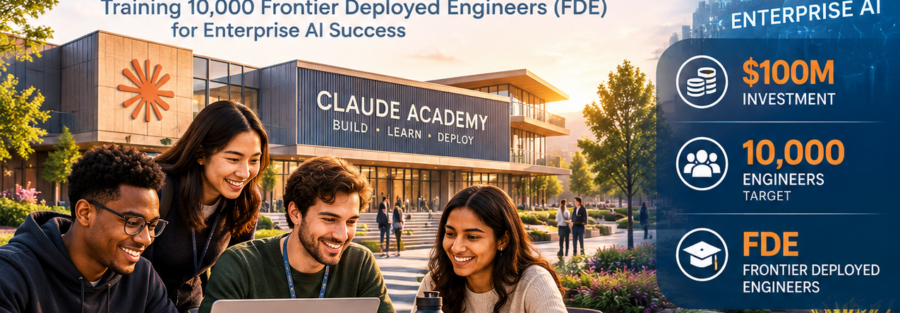
Claude Frontier Academy is Anthropic’s $100 million bet that the biggest barrier to enterprise AI success isn’t the model it’s the people who know how to deploy it. Launched on October 2, the academy aims to train and certify 10,000 “Frontier Deployed Engineers” by the end of 2027, drawing its first cohorts from Accenture, Bain, Capgemini, Commonwealth Bank of Australia, Deloitte, McKinsey, Morgan Stanley, and Novo Nordisk. It’s a direct response to a problem nearly every enterprise AI strategy runs into eventually: powerful AI tools sitting idle because almost nobody inside the organization knows how to turn them into production systems.
What Claude Frontier Academy Actually Trains People to Do
The program doesn’t teach general AI literacy it certifies engineers to build production-grade systems using Anthropic’s own architecture and safety protocols, to the same standard Anthropic holds its internal engineers to. According to Steve Corfield, Anthropic’s Global Head of Business Development and Partnerships, “Claude Frontier Academy trains people the way our own engineers learn, and we want those who graduate to set the standard for how AI gets built inside a business.”
The training path is deliberately rigorous. Participants begin with multi-day, in-person instruction, move into a simulated enterprise deployment designed to mirror the chaos of a real corporate rollout, and finish with a 12-week residency running actual Claude projects inside their own employer’s systems. Graduates earn one of two credentials Claude Resident Engineer or the more advanced Claude Frontier Deployed Engineer with the first badges expected in early 2027.
Claude Frontier Academy at a Glance
| Detail | Fact |
|---|---|
| Total investment | $100 million |
| Training target | 10,000 Frontier Deployed Engineers by end of 2027 |
| Launch date | October 2, 2026 |
| First cohort size | 100 engineers |
| Founding partner firms | Accenture, Bain, Capgemini, Commonwealth Bank of Australia, Deloitte, McKinsey, Morgan Stanley, Novo Nordisk |
| Training structure | In-person instruction, simulated deployment, 12-week residency |
| First certifications expected | Early 2027 |
| Context | Announced as Anthropic nears a reported IPO |
Why Anthropic Is Betting on People, Not Just Model Performance
Every AI lab claims the smartest model few claim the best-trained deployment workforce. As one analysis of the launch put it, every AI lab will tell you its model is smarter than the last one; training 10,000 engineers at firms like Accenture, Deloitte, and McKinsey to build specifically on Claude, using Anthropic’s own deployment standards, builds something closer to a structural advantage than a benchmark score ever could.
Safety positioning doubles as a sales pitch. By building AI safety protocols directly into the certification process, Anthropic is implicitly arguing that safety functions as a prerequisite for genuine enterprise-grade deployment positioning the “safe” choice as also the most technically robust one, at a moment when enterprise buyers are increasingly wary of ungoverned AI agents.
The timing lines up with Anthropic’s own growth trajectory. The announcement lands as Anthropic reportedly prepares for a possible IPO, with a leaked S-1 reportedly showing close to $4.6 billion in revenue against an operating loss above $8 billion context that makes a $100 million enterprise talent investment look less like generosity and more like a deliberate land grab for enterprise deployment share ahead of going public.
The Risk Worth Watching: Talent Lock-In
Several analyses of the launch flagged the same structural risk: if these 10,000 engineers become the primary architects of enterprise AI inside their firms, they may be reluctant to adopt newer or potentially superior models from competitors later, regardless of technical merit. Training an engineer deeply on one vendor’s architecture creates expertise but it also creates switching costs that outlast the original business case for choosing that vendor.
What This Means for Enterprises Evaluating AI Talent Strategy
The talent gap is now a competitive battleground, not just an internal HR problem. When a frontier AI lab commits nine figures specifically to closing a deployment skills gap, that’s a strong signal the gap is real and already shaping which companies can actually operationalize AI versus which ones stay stuck in pilot mode.
Vendor-sponsored training comes with a strategic trade-off. Programs like Claude Frontier Academy offer genuinely rigorous, high-quality training but they also train talent specifically toward one vendor’s ecosystem. Enterprises should weigh the value of that depth against the lock-in risk it creates.
This validates a pattern worth building internally, regardless of vendor. Whether or not your organization partners directly with Anthropic, the model Claude Frontier Academy demonstrates rigorous, hands-on, production-grade AI deployment training rather than surface-level tool familiarity is the right bar to hold any internal AI upskilling effort to.
Frequently Asked Questions
What is Claude Frontier Academy? Claude Frontier Academy is a $100 million training program launched by Anthropic on October 2, 2026, designed to certify 10,000 “Frontier Deployed Engineers” capable of building production-grade AI systems using Anthropic’s own architecture and safety standards by the end of 2027.
Who can join Claude Frontier Academy? The program draws engineers from firms within Anthropic’s Claude Partner Network. Its first cohort included 100 engineers from Accenture, Bain, Capgemini, Commonwealth Bank of Australia, Deloitte, McKinsey, Morgan Stanley, and Novo Nordisk.
How long does the training take? The program includes multi-day in-person instruction, a simulated enterprise deployment with a graded assessment, and a 12-week residency where participants run real Claude projects inside their own employer’s systems before earning certification.
Why is Anthropic investing in training instead of just selling the model? Anthropic has identified the enterprise AI deployment skills gap as a major barrier to adoption training a dedicated workforce to deploy Claude specifically creates both a solution to that gap and a structural advantage over competitors who are training only on model capability.
The Bigger Picture
Claude Frontier Academy captures where the enterprise AI competition is actually heading: the next phase of this race isn’t being fought only in benchmark scores, it’s being fought over who controls the trained talent that turns a model into a working business system. For enterprises, the lesson isn’t necessarily to join one lab’s academy it’s to take the skills gap this program is responding to just as seriously inside your own organization.
Where VisionStratAI helps: Our AI training programmes build the same kind of production-ready, hands-on AI deployment skills Claude Frontier Academy is designed to teach without tying your team’s expertise to a single vendor’s ecosystem. Our AI consulting services help you design a talent strategy that captures the upside of vendor-led training programs while managing the lock-in risk they create.
Sources: Anthropic, Benzinga, Yahoo Finance/Forkast. This article is part of our ongoing coverage of enterprise AI talent strategy and vendor competition.