
Scaling AI Projects: From Pilot to ROI
Introduction
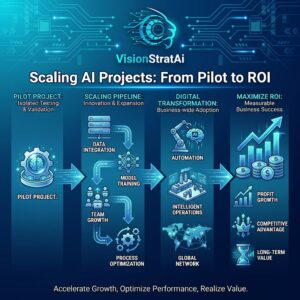
Many organizations successfully launch AI pilot projects. However, only a small percentage manage to scale those initiatives into enterprise-wide impact and measurable return on investment (ROI). Moving from experimentation to transformation is where most AI projects fail.
Scaling AI projects requires more than technology — it demands strategy, governance, infrastructure, and most importantly, trained teams capable of integrating AI into core business operations.
This article explores how businesses can scale AI projects effectively and turn pilots into sustainable ROI.
Why AI Projects Fail to Scale
AI pilots often show promising results in controlled environments. Yet scaling introduces complexity:
- Data silos across departments
- Lack of internal AI expertise
- Weak governance frameworks
- Integration challenges with legacy systems
- Unclear business objectives
Without alignment between strategy and execution, AI initiatives remain isolated experiments.
The 5 Stages of Scaling AI Projects
1. Define Clear Business Objectives
Before scaling, leaders must align AI initiatives with measurable business outcomes.
Key questions:
- What KPI will AI improve?
- How does AI align with company strategy?
- What financial impact is expected?
Scaling without defined ROI targets increases risk and inefficiency.
2.Strengthen Data Infrastructure
AI performance depends on high-quality, accessible data. Organizations must:
- Break down data silos
- Implement secure data governance
- Standardize data collection processes
Reliable data pipelines are essential for scalable AI.
3.Build Cross-Functional Collaboration
Scaling AI requires coordination between:
- IT & Data teams
- Product & Marketing
- Operations
- Executive leadership
AI is not a single-department initiative — it is an enterprise transformation.
4. Invest in AI Training
One of the most critical success factors in scaling AI projects is workforce capability.
AI training helps teams:
- Understand machine learning outputs
- Interpret predictive insights
- Align AI tools with business workflows
- Measure performance and ROI
Without training, even the best AI systems remain underutilized.
5. Implement Governance & Monitoring
Scalable AI requires structured oversight:
- AI ethics and compliance frameworks
- Risk management policies
- Continuous performance monitoring
- Bias detection mechanisms
Governance ensures long-term sustainability and trust.
Real-World Examples of Scaling AI
- Retail: Demand Forecasting at Scale
A retail company may start with AI-based demand forecasting in one region. After validating results, the model can expand globally, optimizing inventory across all stores.
Result:
- Reduced stockouts
- Lower inventory costs
- Increased revenue
Telecom: Predictive Maintenance Expansion
A telecom provider may pilot AI for network failure prediction in one area. After proving efficiency gains, the system can scale nationwide.
Result:
- Reduced downtime
- Lower maintenance costs
- Improved customer satisfaction
Finance: Fraud Detection Optimization
Financial institutions often begin with AI fraud detection for specific transactions. Scaling allows protection across all digital channels.
Result:
- Enhanced security
- Reduced fraud losses
- Stronger compliance
Measuring ROI from AI at Scale
To ensure AI projects deliver ROI, organizations should track:
- Operational cost reduction
- Revenue growth from AI initiatives
- Productivity improvements
- Customer retention rates
- Risk mitigation outcomes
ROI measurement must be continuous, not one-time.
Key Success Factors for AI Scaling
✔ Strong executive sponsorship
✔ Clear AI strategy roadmap
✔ Skilled AI-ready workforce
✔ Scalable cloud infrastructure
✔ Ethical and regulatory compliance
Organizations that treat AI as a long-term capability — not a short-term experiment — are more likely to succeed.
Conclusion
Scaling AI projects from pilot to ROI is a strategic journey, not a technical upgrade. Businesses that invest in infrastructure, governance, and AI training can transform isolated experiments into enterprise-wide impact.
The future belongs to organizations that move beyond AI pilots and build scalable, intelligence-driven ecosystems.