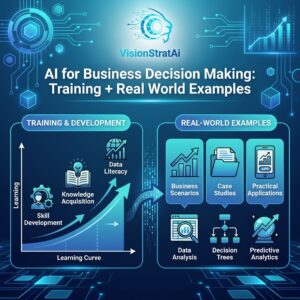
AI for Business Decision Making: Training + Real-World Examples
Introduction
Artificial Intelligence (AI) is transforming how organizations make strategic and operational decisions. Instead of relying solely on intuition, historical reports, or fragmented data, businesses now use AI-driven insights to make faster, smarter, and more accurate decisions.
However, AI tools alone are not enough. To unlock real value, companies must combine AI technology with structured training that enables leaders and teams to interpret insights and apply them effectively.
This article explores how AI improves business decision-making, why training is essential, and real-world examples of AI in action.
Why AI Is Transforming Business Decision-Making
Modern businesses operate in environments defined by data overload, market volatility, and rapid technological change. AI enhances decision-making by:
- Processing large volumes of structured and unstructured data
- Identifying patterns invisible to human analysis
- Predicting outcomes based on historical trends
- Providing real-time insights for faster responses
AI shifts decision-making from reactive to predictive.
Key Benefits of AI for Business Decisions
1. Data-Driven Accuracy
AI reduces human bias by relying on data models rather than assumptions. Predictive analytics helps leaders evaluate risks and opportunities with greater confidence.
2. Faster Strategic Responses
AI systems provide real-time dashboards and automated insights, enabling organizations to respond quickly to market changes.
3. Improved Forecasting
Machine learning models improve forecasting accuracy in areas such as:
- Sales predictions
- Demand forecasting
- Financial planning
- Resource allocation
4. Competitive Advantage
Organizations that use AI-driven decision frameworks gain strategic clarity and operational efficiency, positioning themselves ahead of competitors.
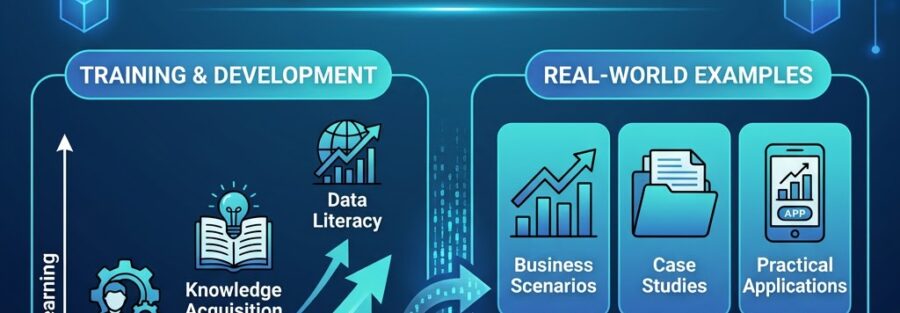
Real-World Examples of AI in Business Decision-Making
Example 1: Retail Demand Forecasting
Retail companies use AI models to predict product demand based on seasonal trends, customer behavior, and external factors. This reduces overstock and stockouts while improving revenue performance.
Example 2: Financial Risk Analysis
Banks and financial institutions apply AI to detect fraud patterns and assess credit risk in real time, improving both security and profitability.
Example 3: Marketing Campaign Optimization
AI analyzes customer engagement data to determine which campaigns drive the highest return on investment (ROI). Businesses can then reallocate budgets toward high-performing strategies.
Example 4: Telecom Network Optimization
Telecom providers use AI to predict network congestion and equipment failures, enabling proactive maintenance and improved service quality.
Why AI Training Is Critical for Decision-Making
Despite AI’s capabilities, many organizations fail to extract value due to a lack of internal skills.
AI training ensures that teams can:
- Understand predictive models and analytics outputs
- Interpret dashboards correctly
- Align AI insights with strategic objectives
- Measure AI ROI effectively
Without proper training, AI remains underutilized.
Building an AI-Driven Decision Culture
To integrate AI successfully, businesses should:
✔ Develop AI Literacy Across Teams
Every department should understand how AI supports their decision processes.
✔ Train Leadership in AI Strategy
Executives must learn how to embed AI into long-term business planning.
✔ Implement Practical AI Workshops
Hands-on training using real business scenarios improves adoption and confidence.
✔ Encourage Cross-Functional Collaboration
AI-driven decisions require alignment between product, marketing, finance, and operations teams.
Business Impact of AI-Driven Decision-Making
Companies that invest in AI training and strategic integration achieve:
- Higher operational efficiency
- Reduced risk exposure
- Improved customer experience
- Faster innovation cycles
- Sustainable competitive growth
AI transforms decision-making from intuition-based to intelligence-driven.
Conclusion
AI for business decision-making is no longer optional — it is a strategic necessity. Organizations that combine advanced AI tools with structured training programs empower their teams to make smarter, faster, and more confident decisions.
The future belongs to businesses that do not just adopt AI, but truly understand how to apply it.