

 Importance of AI in Finance Training & Use Cases
Introduction
The finance industry is undergoing a major transformation as institutions face increasing regulatory pressure, rising cybersecurity risks, massive data volumes, and evolving customer expectations. Artificial Intelligence (AI) is no longer a futuristic concept — it has become a strategic enabler of efficiency, accuracy, and competitive advantage. However, successfully implementing AI in finance requires more than technology alone. Financial professionals must be properly trained to translate AI capabilities into measurable business outcomes.
AI in finance training equips teams with the skills needed to analyze data intelligently, automate complex processes, and enhance strategic decision-making.
Why AI Is Essential in Finance
AI enables financial institutions to move beyond traditional manual analysis by leveraging advanced algorithms to process large datasets in real time. Banks, insurance companies, fintech firms, and financial departments increasingly rely on AI to improve accuracy, reduce risk, and enhance customer service.
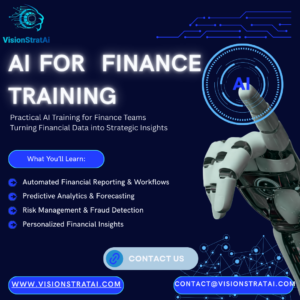
AI enhances:
- Risk assessment through advanced predictive modeling
- Fraud detection using real-time anomaly detection
- Operational efficiency by automating repetitive financial tasks
- Customer insights with data-driven personalization
Key AI Use Cases in Finance
1. Fraud Detection & Prevention
AI systems analyze transaction patterns and detect unusual activities instantly. This helps financial institutions prevent fraud, reduce financial losses, and strengthen cybersecurity.
2. Credit Scoring & Risk Assessment
Machine learning models evaluate creditworthiness using multiple variables beyond traditional scoring methods. This improves lending decisions while minimizing risk exposure.
3. Algorithmic Trading & Investment Analysis
AI processes market data at high speed, identifying patterns and trends that support smarter investment decisions and portfolio optimization.
4. Financial Forecasting & Predictive Analytics
AI-driven analytics enable finance teams to forecast revenue, cash flow, and market trends with higher precision, supporting strategic planning and budgeting.
5. Process Automation (RPA + AI)
AI combined with automation tools streamlines repetitive processes such as invoice processing, compliance checks, and financial reporting, improving productivity and reducing errors.
Why Finance Teams Need AI Training
While AI technologies offer powerful capabilities, financial professionals must understand how to interpret outputs, manage risks, and integrate AI tools into regulatory frameworks.
- AI training enables finance professionals to:
- Understand how machine learning models apply to financial data
- Interpret predictive analytics results accurately
- Apply AI solutions to compliance and risk management challenges
- Collaborate effectively with data scientists and technology teams
Training ensures AI becomes a strategic asset rather than a black-box tool.
Business Impact of AI Training
Investing in AI training delivers measurable value for finance organizations, including:
- Reduced operational costs through automation
- Improved fraud prevention and risk management
- Faster financial decision-making with real-time insights
- Increased accuracy in forecasting and reporting
Organizations that build internal AI capabilities are better positioned to innovate, remain compliant, and stay competitive in an increasingly data-driven financial environment.
Conclusion
AI is transforming the financial industry by enabling smarter risk management, enhanced fraud detection, and more accurate forecasting. However, the full potential of AI is realized only when finance professionals are trained to understand and apply these technologies effectively. Practical AI training empowers teams to turn financial data into strategic advantage and sustainable growth.
Discover VisionStratAI’s AI Training for Finance Professionals to accelerate your team’s AI capabilities and create real business impact.