



Why Most AI PoCs Fail And How to Industrialize AI at Scale
Artificial Intelligence is no longer a futuristic promise. Most large organizations have already launched multiple AI Proofs of Concept (PoCs).
Yet, despite significant investments, more than 70% of AI PoCs never reach production. The issue is not the algorithms. The issue is
industrialization. This article explains why AI PoCs fail and provides a pragmatic framework to move from experimentation to scalable,
business-critical AI.
Introduction
Artificial Intelligence is no longer a futuristic promise. Most large organizations have already launched multiple AI Proofs of Concept (PoCs).
Yet, despite significant investments, more than 70% of AI PoCs never reach production.
The issue is not the algorithms.
The issue is industrialization.
This article explains why AI PoCs fail and provides a clear, pragmatic framework to move from
experimentation to scalable, business-critical AI.
Why AI PoCs Fail
1) PoCs Are Built in Isolation
Many AI PoCs are developed by:
- Small innovation teams
- External vendors
- Data scientists disconnected from operations
They succeed in demos but fail in real environments because they are not integrated into existing processes, systems,
and constraints.
AI does not live in a vacuum. It must coexist with legacy IT, operational KPIs, security, and governance.
2) No Clear Business Ownership
AI initiatives often lack:
- A clear business sponsor
- Defined success metrics
- Financial accountability
When AI is treated as an “innovation experiment” instead of a business transformation lever, it never becomes mission-critical.
3) Data Is Not Production-Ready
Common data issues include:
- Poor data quality
- Manual data preparation
- No real-time or near-real-time pipelines
- Weak data ownership
A PoC can survive on handcrafted datasets. A production AI system cannot.
4) No MLOps or Industrial Architecture
Many organizations underestimate:
- Model lifecycle management
- Monitoring and retraining
- Versioning and rollback
- Security and compliance
Without MLOps, AI remains fragile, costly, and untrustworthy.
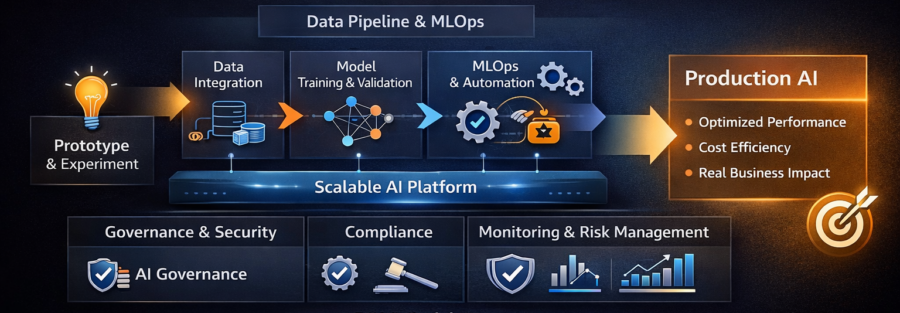
How to Industrialize AI at Scale
Step 1: Start With Business Value, Not Models
Successful AI programs begin with:
- A quantified business problem
- Clear KPIs (cost, revenue, performance, risk)
- A committed business owner
AI must be accountable to P&L impact, not technical elegance.
Step 2: Design for Production From Day One
Industrial AI requires:
- Scalable cloud-native architecture
- Integration with operational systems
- Security and compliance by design
If a PoC cannot scale technically and organizationally, it should not start.
Step 3: Build a Robust Data Foundation
Key enablers include:
- Automated data pipelines
- Clear data ownership
- Data quality controls
- Real-time or event-driven ingestion where relevant
Data engineering is not optional—it is the core of AI success.
Step 4: Implement MLOps as a Standard Capability
Industrial AI demands:
- Automated deployment
- Continuous monitoring
- Retraining pipelines
- Model governance
MLOps turns AI from a one-off project into a repeatable capability.
Step 5: Embed AI Into Operations
AI delivers value only when it is:
- Integrated into decision workflows
- Trusted by operational teams
- Used daily, not occasionally
Adoption matters as much as accuracy.
Conclusion
AI PoCs fail not because AI does not work, but because organizations do not treat AI as an industrial system.
The winners are those who:
- Align AI with business value
- Build production-grade architectures
- Invest in data and MLOps
- Embed AI into real operations
AI at scale is not about experimentation—it is about execution.


2 Comments
Riva Collins
It’s no secret that the digital industry is booming. From exciting startups to need ghor
global and brands, companies are reaching out.
Obila Doe
It’s no secret that the digital industry is booming. From exciting startups to need ghor hmiu
global and brands, companies are reaching out.