How AI Is Transforming Product Strategy in Modern Businesses
Introduction
Artificial Intelligence (AI) is rapidly reshaping how companies design, develop, and scale products. In today’s competitive environment, businesses can no longer rely solely on intuition or traditional market research. Instead, AI-driven insights are enabling organizations to make smarter, faster, and more data-informed product decisions.
From customer behavior analysis to predictive forecasting, AI is transforming product strategy into a more agile, customer-centric, and performance-driven process.
Why AI Is Essential in Product Strategy
Modern product strategy requires deep understanding of customer needs, market trends, and competitive positioning. AI empowers product teams to:
- Analyze large volumes of customer data in real time
- Predict future demand and usage patterns
- Identify product-market fit faster
- Optimize pricing and feature prioritization
- Reduce risks in product development
By leveraging AI, companies can move from reactive decision-making to proactive strategy planning.
Key Ways AI Transforms Product Strategy
1. Data-Driven Product Decisions
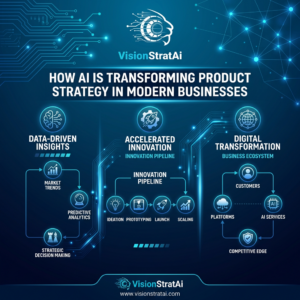
AI analyzes customer behavior, usage patterns, and feedback to provide actionable insights. Instead of guessing which feature to build next, product managers can prioritize based on predictive analytics and real user data.
SEO Insight: Businesses searching for AI product strategy solutions often seek better data utilization and decision frameworks.
2. Predictive Market Analysis
AI models forecast trends and market shifts, helping businesses stay ahead of competitors. This is especially valuable in fast-moving industries like technology, telecom, retail, and digital services.
Predictive analytics supports:
- Demand forecasting
- Competitive intelligence
- Early trend detection
3. Customer-Centric Personalization
AI enables real-time personalization of product experiences. By analyzing user interactions, businesses can tailor features, recommendations, and user journeys to increase engagement and retention.
This leads to:
- Higher customer satisfaction
- Improved lifetime value (LTV)
- Stronger brand loyalty
4. Faster Product Development Cycles
AI accelerates product testing and iteration through automated A/B testing, performance monitoring, and intelligent feedback analysis.
Instead of waiting months for validation, teams can:
- Test multiple features simultaneously
- Measure real-time performance
- Optimize continuously
5. Smarter Pricing Strategies
Dynamic pricing models powered by AI adjust pricing based on demand, competition, and customer behavior. This maximizes revenue while maintaining competitiveness.
The Role of AI Training in Product Strategy
While AI tools are powerful, their effectiveness depends on how well teams understand and apply them.
AI training enables product managers and business leaders to:
- Interpret AI-generated insights
- Align AI tools with strategic goals
- Integrate machine learning into decision workflows
- Measure ROI from AI initiatives
Without proper training, AI risks becoming underutilized technology rather than a strategic advantage.
Business Impact of AI-Driven Product Strategy
Organizations that integrate AI into their product strategy achieve:
- Faster time-to-market
- Higher product success rates
- Reduced development costs
- Increased customer retention
- Sustainable competitive advantage
AI shifts product strategy from reactive adjustments to predictive innovation.
Conclusion
AI is transforming product strategy in modern businesses by enabling smarter decisions, faster innovation, and deeper customer understanding. Companies that combine AI technology with proper training and strategic alignment are better positioned to lead in an increasingly competitive landscape.
To fully unlock the potential of AI in product development and strategy, organizations must invest not only in tools but also in AI education and practical implementation frameworks.