AI Training Roadmap Beginner to Advanced
Introduction
Artificial Intelligence is rapidly becoming a core capability across industries. However, many organizations struggle with one critical challenge: how to structure AI training from beginner to advanced levels.
A clear AI training roadmap ensures that teams build foundational knowledge before progressing to strategic and technical expertise. Without structured learning, AI adoption becomes fragmented and inefficient.
This roadmap outlines how businesses can develop AI capabilities step by step — from awareness to advanced implementation.
Why an AI Training Roadmap Is Essential
AI transformation is not achieved through tools alone. It requires:
- AI literacy across teams
- Strategic alignment from leadership
- Practical application skills
- Continuous learning
A roadmap prevents knowledge gaps and accelerates AI maturity.
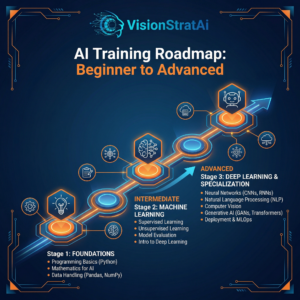
Stage 1: Beginner Level – AI Foundations
At this stage, the objective is awareness and understanding.
Key Focus Areas:
- What is Artificial Intelligence?
- Basic machine learning concepts
- AI use cases across industries
- Data literacy fundamentals
Who Should Attend:
- All employees
- Business managers
- Non-technical teams
Outcome:
Participants understand AI terminology and how AI impacts their roles.
Stage 2: Intermediate Level – Applied AI Skills
Once foundational knowledge is established, teams move toward practical application.
Key Focus Areas:
- Using AI tools for productivity
- Interpreting AI dashboards
- Predictive analytics basics
- AI in decision-making
Who Should Attend:
- Team leaders
- Product managers
- Marketing and operations teams
Outcome:
Teams can apply AI tools to real business scenarios.
Stage 3: Advanced Level – Strategic & Technical AI
At the advanced level, the focus shifts toward strategy, governance, and scalability.
Key Focus Areas:
- AI strategy development
- Scaling AI projects
- AI ethics & governance
- ROI measurement
Who Should Attend:
- Executives
- Senior managers
- AI specialists
Outcome:
Leaders can drive AI transformation and build AI-native capabilities.
Continuous Learning & AI Maturity
AI evolves rapidly. Organizations must implement:
- Ongoing workshops
- Case-based training
- Cross-functional collaboration
- AI governance reviews
AI capability is not a one-time milestone — it is a continuous journey.
Conclusion
An AI training roadmap from beginner to advanced ensures structured capability building, reduces risk, and accelerates digital transformation.
Organizations that invest in progressive AI training create confident, AI-ready teams capable of driving innovation and measurable ROI.