The SpaceX Cursor acquisition remains the largest venture-backed startup acquisition in history, and five months after it closed, it’s become one of the clearest case studies available on how a company decides whether to buy AI capability outright or build it internally. SpaceX finalized its $60 billion all-stock purchase of Anysphere, the company behind the AI coding tool Cursor, in June 2026 a deal that reshaped the AI-developer tools market and offers a genuinely instructive template for any enterprise weighing the same build-versus-buy question on a smaller scale.
How the SpaceX Cursor Acquisition Actually Unfolded
The deal didn’t start as a straightforward acquisition. In April 2026, SpaceX secured an option structure giving it two paths: acquire Cursor outright for $60 billion later in the year, or pay $10 billion for continued collaborative work between the companies. That structure let SpaceX test the partnership’s value before committing to a full buyout “SpaceXAI and Cursor are now working closely together to create the world’s best coding and knowledge work AI,” the companies said at the time, explicitly tying the collaboration to SpaceX’s Colossus training supercomputer infrastructure.
By June, SpaceX exercised the acquisition option in full, converting Anysphere’s outstanding shares into roughly 389 million shares of SpaceX Class A stock. The SpaceX Cursor acquisition became, at that moment, the largest venture-backed startup acquisition in history. The timing was notable: the deal closed just days after SpaceX’s own IPO, which raised more than $80 billion and valued the company above $2 trillion giving SpaceX unusually fresh stock currency to fund an all-stock transaction at scale.
The Strategic Logic Behind the Price Tag
At $60 billion, Cursor’s valuation dwarfed typical SaaS acquisition multiples. Cursor’s business had scaled rapidly since its 2022 founding, reaching roughly $2.6-3 billion in annualized revenue with enterprise sales accelerating implying a purchase multiple in the 20-25x ARR range, well above typical enterprise software benchmarks. That premium reflects what SpaceX was actually buying: not just a product, but distribution to expert software engineers and a direct path to competing with Anthropic and OpenAI’s own coding tools, at a moment when Elon Musk’s merger of SpaceX with xAI made AI capability central to the company’s broader strategy.
The acquisition also had an immediate competitive consequence. It ended Cursor’s existing partnership with OpenAI, which had reportedly projected over $1 billion in annual revenue from that collaboration a reminder that a build-versus-buy decision at this scale doesn’t just add capability to the acquirer, it actively removes it from competitors.
SpaceX Cursor Acquisition Key Facts at a Glance
| Detail | Fact |
|---|---|
| Final deal value | $60 billion, all-stock |
| Deal structure | Converted ~389 million Anysphere shares into SpaceX Class A stock |
| Initial option (April 2026) | Acquire for $60B later, or pay $10B for ongoing collaboration |
| Deal closed | June 2026, days after SpaceX’s $80B+ IPO |
| Cursor’s annualized revenue at acquisition | ~$2.6–3 billion |
| Implied revenue multiple | ~20–25x ARR |
| Competitive impact | Ended Cursor’s OpenAI partnership (projected $1B+ annual revenue) |
| Strategic rationale | Direct-to-engineer distribution + competitive positioning vs. Anthropic and OpenAI coding tools |
What Made This a “Buy” Decision Rather Than a “Build” One
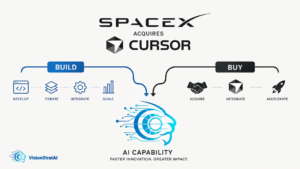
SpaceX, through its xAI division, already had frontier model capability and massive compute infrastructure in its Colossus supercomputer. What it didn’t have was Cursor’s specific product-market fit with software engineers, its existing enterprise sales motion, or its multi-year head start on developer workflow integration. Building that from scratch replicating years of product iteration and a user base already embedded in daily engineering workflows would likely have taken longer and cost more in opportunity cost than the acquisition premium itself, even at 20-25x revenue.
The Information’s reporting on the deal suggests compute costs loomed large in Cursor’s own decision to accept the offer a reminder that the SpaceX Cursor acquisition was shaped by pressures on both sides of the table, not just SpaceX’s strategic ambitions. That’s the core calculus any enterprise facing a build-versus-buy AI decision needs to run honestly: the acquisition price isn’t the only cost of building internally the time-to-market gap and the competitive ground ceded while building are costs too, and they’re easy to underweight when comparing a large upfront number against a seemingly more “efficient” internal roadmap.
What This Means for Enterprise AI Strategy
Distribution and workflow integration are often worth more than the underlying model. SpaceX didn’t need Cursor’s AI capability in isolation it needed Cursor’s existing relationship with software engineers who already used the product daily. Enterprises evaluating AI acquisitions or partnerships should weigh existing user adoption and workflow fit as heavily as raw technical capability.
A staged option structure can de-risk a high-stakes AI bet. SpaceX’s April agreement collaborate first, decide on full acquisition later let it validate the partnership’s value before committing $60 billion. Enterprises don’t need acquisition-scale capital to apply the same logic: pilot a vendor relationship with clear decision gates before committing to a long-term platform dependency.
Consolidation in AI tooling markets accelerates competitive exposure, not just capability gain. The deal didn’t just give SpaceX a coding tool it removed that tool’s revenue and roadmap influence from a direct competitor. Any enterprise relying on a single AI vendor should actively monitor that vendor’s acquisition exposure, since a competitor acquiring your critical AI supplier is a real strategic risk, not a hypothetical one.
Revenue multiples in AI acquisitions reflect strategic scarcity, not just financial performance. A 20-25x ARR multiple only makes sense when the asset being bought is genuinely difficult to replicate on a competitive timeline. Enterprises building their own AI roadmap should honestly assess whether their internal build timeline can realistically compete with a well-funded rival simply acquiring the capability outright.
The Bigger Picture
The SpaceX Cursor acquisition is a useful extreme case precisely because of its scale few organizations will ever face a genuine $60 billion build-versus-buy decision. But the underlying logic scales down cleanly: distribution and workflow integration carry real strategic value beyond the technology itself, staged commitments reduce risk on big AI bets, and vendor concentration is a competitive exposure worth actively managing, whatever size the check is.
Where VisionStratAI helps: Our AI consulting services help organizations structure build-versus-buy decisions for AI capability with the same rigor SpaceX applied at $60 billion scale just sized to your organization’s actual stakes. Our AI training programmes build the strategic judgment your team needs to evaluate AI vendor and acquisition risk before it becomes a competitive liability.