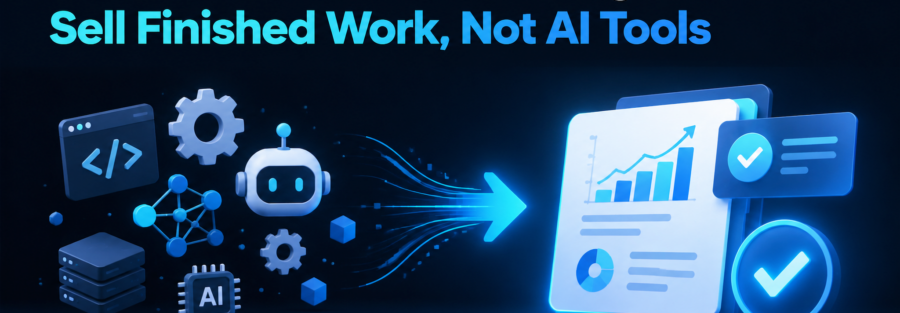
AI outcome pricing means charging for the result an AI agent delivers, not for access to a model. Small businesses do not want tokens, dashboards or licenses. They want the phone answered, the appointment booked and the invoice sent.
Large platforms are already moving in this direction. Meta’s Muse for Small Business connects an AI agent to tools such as QuickBooks, Shopify and Stripe, and is free with usage limits. Industry analyst Sebastian Barros adds that Meta has floated charging only when a result is delivered.
For anyone selling AI, that changes the offer.
In this article
- Why Tool-Based AI Offers Struggle With Small Business
- How AI Outcome Pricing Works in Practice
- The Numbers at a Glance
- What This Means Depends on Who’s Asking
- 5 Steps to Launch AI Outcome Pricing
- The Bigger Picture

Why Tool-Based AI Offers Struggle With Small Business
Many AI offers still ask the customer to do the integration work: a model, a dashboard and a promise.
For a business with a handful of employees and no IT department, that is the wrong product. The owner has no time to design prompts, connect applications or supervise outputs.
The winning offers describe jobs done instead: every incoming call answered, every lead qualified, every booking confirmed.
A plumbing firm does not want a platform. It wants an agent that answers messages and calls, checks the calendar, books the technician, confirms with the customer and triggers the invoice. The agent escalates only what needs the owner.
How AI Outcome Pricing Works in Practice
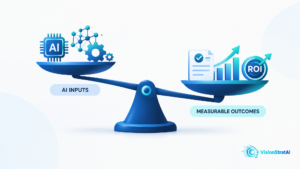
AI outcome pricing ties revenue to a measurable event: a booking confirmed, a lead qualified or a request resolved.
At Brazilian car-rental company Movida, Meta reports daily WhatsApp bookings rose 44% and 85% of conversations were resolved entirely by the AI agent. Results like these are easy to measure, which is what makes them easy to price.
Meta says its Advantage+ advertising products have reached a $75 billion annual revenue run rate by automating work once done by marketers and agencies. Zuckerberg has described charging businesses only when Meta delivers a result, rather than per software seat.
The Numbers at a Glance
| Metric | Figure |
|---|---|
| Small businesses on Meta platforms | 200 million+ |
| Daily active business conversations | 1 billion+ |
| Businesses using Meta Business Agent | 1 million+ |
| Movida (Brazil): increase in daily WhatsApp bookings | +44% |
| Movida: conversations resolved entirely by the AI agent | 85% |
| Meta Advantage+ annual revenue run rate | $75 billion |
| Operator business messaging revenue at risk to OTT (5 years, Juniper Research) | $3.1 billion |
What This Means Depends on Who’s Asking
For a platform, AI outcome pricing is a revenue model: charge when a booking, lead or transaction is delivered.
For a telecom operator or service provider, it is a defensive move. Selling AI as models, tokens and licenses puts them in direct competition with platforms that offer the basics for free.
For a company running AI internally, it is an operating model: define the result first, then build the workflow behind it.
5 Steps to Launch AI Outcome Pricing
- Define the output. Write the result as a sentence a customer or manager would recognize, such as “all supplier queries answered within one hour.”
- Map the workflow end to end. Include the systems, data and exceptions behind the result, not just the model.
- Set the human boundary. Decide in advance what the agent never decides alone, and how exceptions reach a person.
- Measure by outcome, not by usage. Prompts sent and seats activated say little about whether the work got done.
- Start with a limited version and learn. An initial free or basic outcome reveals customer context, such as common questions, systems and exceptions. That context improves the next version and makes the service harder to replace.

The Bigger Picture
Customers pay for work completed. As platforms adopt AI outcome pricing, organizations that package AI as finished work will be better positioned than those selling access to technology.
The skill that matters is describing a process precisely enough for an agent to run it reliably. It starts with committing to a use case first, as we explain in AI Pilot to Scale: What Akamai’s Anthropic Deal Teaches Every Program.
Where VisionStratAI helps: Our AI consulting services help organizations turn AI capabilities into defined, measurable outcomes before committing to an AI outcome pricing or packaging model. Our AI training programmes build the skills managers and operational teams need to specify workflows, test agents against real cases and monitor quality over time.
Related reading
- AI Pilot to Scale: What Akamai’s Anthropic Deal Teaches Every Program
- AI Training by Industry
- AI Training for Retail & eCommerce Teams
- AI Training for Marketing Teams
Want to turn one workflow into a finished-work offer? Talk to an AI expert.