

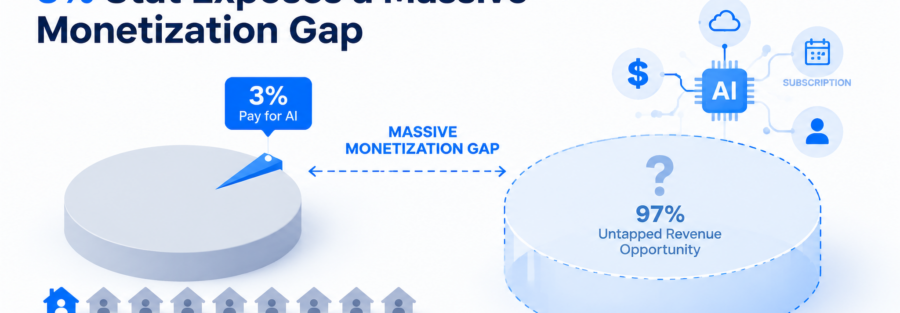
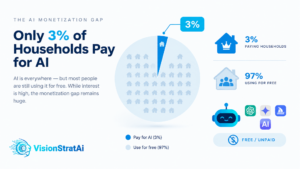
Households paying for AI remain a small minority, even as AI usage goes mainstream. According to Bank of America Institute data covering nearly 70 million consumers, only about 3% of U.S. households were paying for AI services as of early 2026, spending a median of roughly $20 per month. PNC’s independent analysis landed in almost the same place 2.2% of households in its dataset paying for generative AI subscriptions as of May 2026, though at a higher average spend of about $31 a month. The two banks measure different populations using different methods, so their percentages can’t be directly compared, but the overall signal is consistent and significant: AI usage has gone mainstream. AI payment hasn’t.
Why So Few Households Paying for AI Still Report High Usage
The scale of that gap is easy to underestimate. A September 2026 Menlo Ventures survey found 55% of US AI users report paying for at least one AI product but that figure counts anyone using a paid plan, including one someone else is covering, across a population that itself represents 64% of US adults. Bank of America’s methodology is far stricter: it counts every household it banks, matching only payments to merchants it specifically identifies as AI services. That difference in methodology not a contradiction in the underlying reality explains why one survey shows a majority paying and another shows a low single-digit percentage paying directly out of household budgets.
Growth is real, even from a small base. Bank of America recorded 38% more households making AI payments in February 2026 than the 2024 average, and the share of households spending $21–$40 monthly on AI rose 50% over the same period. PNC saw an even steeper trajectory, with its paying-household share climbing roughly 155% year-over-year. Both banks also found the same demographic pattern: households earning above $125,000 and younger generations represent the largest share of current AI spenders, though Bank of America noted the strongest growth coming from the $75,000 $125,000 income band a signal that paid adoption may be starting to spread beyond the earliest, highest-income adopters.
Why “Not Paying” Doesn’t Mean “Not Monetized”
The more important nuance for anyone building an AI business strategy: low direct-subscription payment doesn’t mean AI isn’t being monetized it may mean AI is being monetized indirectly. Bank of America’s own analysis points toward “wrappers” AI capability blended directly into existing applications and subscriptions a household already pays for as the more likely long-term monetization path, rather than consumers adopting AI the way they adopted standalone streaming subscriptions. In that framing, a meaningful share of Americans may already be paying for AI without perceiving themselves as an “AI customer” at all the cost is simply folded into a product they already use.
There’s also a real adoption ceiling to reckon with. A CivicScience survey cited in Bank of America’s analysis found 37% of respondents said none of AI’s common uses felt practical or helpful in their day-to-day lives a meaningful signal that the industry’s monetization challenge isn’t purely about pricing or packaging. For over a third of consumers surveyed, the value proposition itself hasn’t yet landed.
The Numbers at a Glance
| Metric | Figure |
|---|---|
| Bank of America: households paying for AI (early 2026) | ~3% |
| PNC: households paying for AI (May 2026) | 2.2% |
| Menlo Ventures: AI users who report paying for at least one product | 55% |
| Bank of America median monthly AI spend per paying household | ~$20 |
| PNC average monthly AI spend per paying household | ~$31 |
| Bank of America YoY growth in paying households | +38% (vs. 2024 average) |
| PNC YoY growth in paying households | ~+155% |
| Consumers who say no common AI use case feels helpful (CivicScience) | 37% |
| Bank of America’s projected consumer AI market size | ~$75 billion annually |
What This Means Depends Entirely on Who’s Asking
This is genuinely a case where the same data supports two very different conclusions, depending on the business model asking the question. For an AI lab selling direct subscriptions, 97% of households not paying directly is a demand problem a signal that today’s pricing, packaging, or perceived value isn’t yet converting mainstream usage into mainstream willingness to pay. For a business whose model depends on bundling AI into something customers already pay for a telecom plan, a productivity suite, a financial services product that same 97% looks like a largely untapped distribution opportunity: proof that demand and usage already exist, waiting for the right packaging to convert it into revenue without asking the customer to open a new line item.
What This Means for Enterprise AI Strategy
Standalone AI subscription pricing faces real headwinds outside premium and enterprise segments. Before committing to a direct-to-consumer subscription model for AI capability, organizations should weigh evidence that most usage today isn’t converting into direct payment at anywhere near the rate AI investment levels might suggest.
Bundling may be the more defensible monetization path for most organizations. If AI capability can be folded into a product or service a customer already pays for, that path appears better aligned with how consumer AI monetization is actually trending than standalone subscription products competing for a new line item in household budgets.
The income and generational skew in paying segments should inform go-to-market targeting. With higher-income and younger households currently overrepresented among AI payers and the $75K–$125K income band now showing the fastest growth pricing and positioning strategies built around only the highest-income segment may be leaving the fastest-growing segment underserved.
“High usage, low payment” is a signal to investigate, not necessarily a red flag. For enterprises already embedding AI into existing products, strong usage without direct payment may indicate the model is working as a value-add rather than failing as a revenue driver the two shouldn’t automatically be conflated.
The Bigger Picture
The small share of households paying for AI isn’t evidence that consumer AI monetization is failing it’s evidence that the monetization model hasn’t been fully worked out yet, and multiple paths remain genuinely open. Whether that 97% represents an unconverted market or an already-converted one running through someone else’s subscription depends entirely on where in the value chain a given business sits and getting that read right matters more to AI strategy right now than the headline percentage itself.
Where VisionStratAI helps: Our AI consulting services help organizations evaluate whether a standalone AI monetization model or an embedded, bundled approach better fits their market position before committing to a pricing strategy the data doesn’t support. Our AI training programmes build the strategic judgment teams need to read market signals like this one accurately.
Sources: Bank of America Institute (“Not Quite mAInstream: A Consumer AI Profile,” March 2026), PNC Economics Research (June 2026 Consumer Health Check), Menlo Ventures (September 2026 survey), analysis adapted from Sebastian Barros’ newsletter (October 7, 2026). This article is part of our ongoing coverage of AI market adoption and monetization strategy.