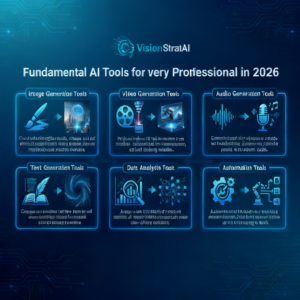
Fundamental AI Tools for Every Professional in 2026
Introduction
In 2026, Artificial Intelligence is no longer a competitive advantage — it is a professional baseline. Across industries, AI tools are embedded into daily workflows, reshaping how professionals analyze data, communicate, strategize, and innovate.
The question is no longer “Should I use AI?”
It is “Do I know how to use AI effectively?”
Understanding the fundamental AI tools shaping the modern workplace is now essential for staying relevant and future-ready.
The Shift Toward AI-Augmented Professionals
The modern workforce is evolving from task execution to intelligence amplification. AI tools are designed not to replace professionals, but to enhance their thinking, speed, and precision.
Professionals who integrate AI effectively can:
- Make faster data-driven decisions
- Improve accuracy and reduce human error
- Increase creativity and strategic thinking
- Focus on high-value activities
AI is becoming the co-pilot of the modern professional.
The Core Categories of AI Tools in 2026
Rather than focusing on specific brands, professionals must understand the categories of AI tools transforming business environments.
1. Generative Intelligence Platforms
These tools assist in writing, summarizing, brainstorming, coding, and problem-solving.
Impact on professionals:
- Faster content creation
- Improved communication clarity
- Accelerated idea generation
Generative AI is redefining productivity across marketing, consulting, HR, and leadership roles.
2. Decision Intelligence Systems
AI-powered analytics platforms provide predictive insights, scenario modeling, and risk forecasting.
These tools support:
- Strategic planning
- Financial modeling
- Performance optimization
Decision intelligence is becoming central to executive leadership.
3. Automation & Workflow Optimization Tools
Intelligent automation eliminates repetitive processes and enhances operational efficiency.
Applications include:
- Email automation
- CRM management
- Supply chain monitoring
- HR onboarding workflows
Automation frees professionals to focus on strategic initiatives.
3. Personalization & Customer Insight Engines
AI enables deep understanding of customer behavior, preferences, and engagement patterns.
Professionals in retail, telecom, finance, and marketing use these tools to:
- Improve customer journeys
- Optimize campaigns
- Increase retention
Customer intelligence is becoming a strategic differentiator.
4. AI Governance & Compliance Systems
As regulations expand globally, professionals must ensure ethical and responsible AI usage.
Governance tools help organizations:
- Monitor bias
- Ensure regulatory compliance
- Maintain transparency
Responsible AI is now a leadership responsibility.
5. Why AI Literacy Matters More Than Tools
Access to AI tools is no longer the barrier — capability is.
Professionals must develop AI literacy to:
- Understand model limitations
- Interpret outputs critically
- Avoid blind reliance on automation
- Align AI use with business strategy
Without training, AI becomes a shortcut. With training, AI becomes a multiplier.
6. The Competitive Advantage of AI-Ready Professionals
In 2026, the most successful professionals will not necessarily be technical experts — they will be AI-enabled strategists.
They will:
-
Ask better questions
-
Use AI to validate decisions
-
Combine human judgment with machine intelligence
-
Continuously adapt to emerging AI innovations
The future of work belongs to professionals who collaborate with AI, not compete against it.
Conclusion
Fundamental AI tools are reshaping professional performance across industries. From generative intelligence to decision-support systems, AI is becoming embedded in everyday business operations.
However, the real transformation happens when professionals move beyond tool usage and build strategic AI capability.
AI is no longer optional — it is foundational to modern excellence.