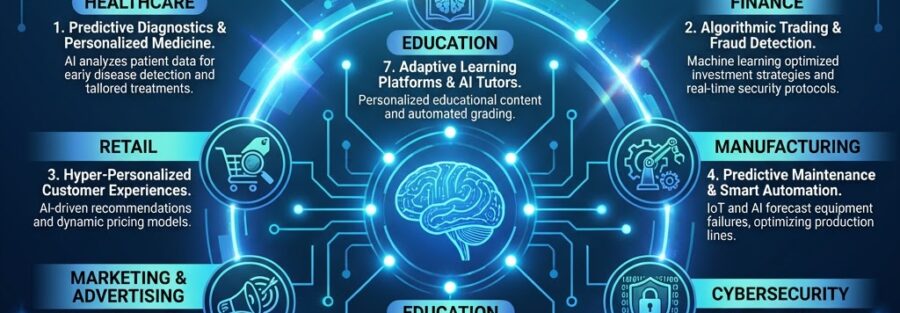
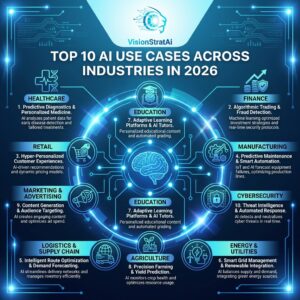
Top 10 AI Use Cases Across Industries in 2026
Introduction
Artificial Intelligence (AI) continues to reshape industries at an unprecedented pace. In 2026, AI is no longer an experimental technology — it is a core driver of innovation, efficiency, and competitive advantage.
From predictive analytics to intelligent automation, organizations across telecom, retail, finance, healthcare, and marketing are leveraging AI to transform operations and decision-making.
This article explores the top 10 AI use cases across industries in 2026, highlighting how businesses are generating measurable impact through AI adoption.
Why AI Adoption Is Accelerating in 2026
Several factors are driving AI growth:
- Increased data availability
- Advanced machine learning models
- Cloud computing scalability
- Growing demand for automation
- Competitive pressure for innovation
Companies that strategically integrate AI are outperforming traditional competitors.
Top 10 AI Use Cases Across Industries in 2026
1. Predictive Maintenance (Telecom & Manufacturing)
AI analyzes equipment data to predict failures before they occur. This reduces downtime, lowers maintenance costs, and improves operational efficiency.
Impact:
- Reduced service interruptions
- Cost savings
- Improved reliability
2. Personalized Customer Experiences (Retail & Marketing)
AI-driven recommendation engines personalize content, offers, and product suggestions based on customer behavior.
Impact:
- Higher conversion rates
- Increased customer loyalty
- Improved lifetime value
3. Fraud Detection & Risk Analysis (Finance & Insurance)
AI models detect unusual transaction patterns in real time, minimizing fraud and financial risk.
Impact:
- Stronger security
- Reduced financial losses
- Improved compliance
3. AI-Powered Chatbots & Virtual Assistants
Businesses use AI chatbots for 24/7 customer support, automating responses and improving service speed.
Impact:
- Lower operational costs
- Faster customer resolution
- Enhanced user experience
4. Demand Forecasting & Supply Chain Optimization
AI predicts demand trends and optimizes inventory levels, preventing stock shortages and overstock.
Impact:
- Increased efficiency
- Reduced waste
- Better resource planning
5. Dynamic Pricing Strategies (Retail & Travel)
AI adjusts pricing based on demand, competitor pricing, and customer behavior.
Impact:
- Revenue optimization
- Competitive positioning
- Market responsiveness
6. Healthcare Diagnostics & Predictive Care
AI assists medical professionals in diagnosing diseases and predicting patient risks using data-driven models.
Impact:
- Improved accuracy
- Faster diagnosis
- Better patient outcomes
7. Marketing Campaign Optimization
AI analyzes campaign performance data to reallocate budgets toward high-performing channels.
Impact:
- Improved ROI
- Data-driven targeting
- Better audience segmentation
8. Workforce Analytics & HR Automation
AI supports recruitment, talent management, and employee performance analysis.
Impact:
- Smarter hiring decisions
- Improved retention
- Increased productivity
9. Strategic Decision-Making & Business Intelligence
AI supports executive decision-making by providing predictive insights and real-time dashboards.
Impact:
- Faster strategy execution
- Reduced risk
- Stronger competitive advantage
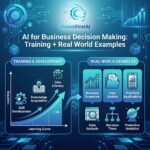
The Importance of AI Training in 2026
While AI use cases are expanding rapidly, the real differentiator lies in how well organizations train their teams.
AI training enables businesses to:
- Understand AI tools and predictive models
- Interpret data insights effectively
- Align AI initiatives with strategic goals
- Scale AI across departments
Without proper training, AI adoption often remains fragmented and underutilized.
Conclusion
The top 10 AI use cases across industries in 2026 demonstrate that AI is no longer limited to one sector — it is a cross-industry transformation engine.
Organizations that combine AI implementation with structured training and strategic integration will lead the next wave of digital innovation.
The future belongs to businesses that are not just AI-enabled, but truly AI-driven.