AI-Native Companies Why They Win & How to Train for It
Introduction
AI-native companies are redefining how modern businesses operate, compete, and grow. Unlike traditional organizations that simply add Artificial Intelligence (AI) tools to existing systems, AI-native companies build their entire strategy, operations, and culture around AI from the start.
As digital transformation accelerates, businesses are asking a critical question:
Why do AI-native companies outperform competitors — and how can we train teams to think and operate the same way?
What Is an AI-Native Company?
An AI-native company is an organization that integrates AI into its core business model, decision-making processes, product development, and customer experience.
Instead of using AI as a support tool, these companies:
- Design products powered by AI from day one
- Make decisions based on real-time data and predictive models
- Automate operations intelligently
- Continuously learn and optimize through machine learning
AI is not a department — it is the foundation.
Why AI-Native Companies Win
1. Faster Decision-Making
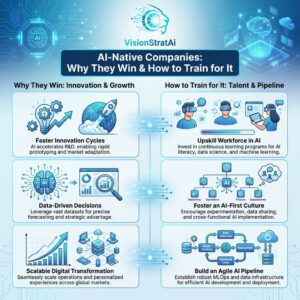
AI-native companies rely on predictive analytics and automated insights, allowing leaders to make data-driven decisions in real time. This reduces delays and minimizes strategic errors.
2. Continuous Product Optimization
Machine learning models constantly analyze user behavior and improve products dynamically. This creates faster iteration cycles and better product-market fit.
3. Scalable Personalization
AI-native businesses personalize experiences at scale. Whether in telecom, retail, finance, or marketing, AI enables real-time customization based on customer behavior.
Result:
- Higher engagement
- Improved retention
- Increased revenue
4. Operational Efficiency
From supply chain automation to intelligent resource allocation, AI-native companies reduce operational costs while improving performance.
Automation is not just about efficiency — it becomes a competitive advantage.
5. Innovation as a Culture
AI-native organizations foster a culture of experimentation. Teams use AI insights to test ideas, measure impact, and iterate quickly.
This agility allows them to stay ahead in fast-changing markets.
The Skills Gap Challenge
Despite the advantages, many traditional companies struggle to become AI-driven because of one major barrier:
The AI skills gap.
Adopting AI technology without properly trained teams often leads to underutilized tools, misinterpretation of data, and failed transformation initiatives.
Technology alone does not create AI-native capability — people do.
How to Train for an AI-Native Mindset
To transition toward an AI-native model, businesses must focus on structured AI training programs.
1. Build AI Fundamentals Across Teams
Employees should understand:
- Machine learning basics
- Data interpretation
- AI use cases relevant to their industry
2. Train Leaders in AI Strategy
Executives and product leaders must learn how to:
- Align AI with business goals
- Measure AI ROI
- Identify high-impact opportunities
3. Develop Practical AI Skills
Training should include:
- Hands-on AI tools
- Real business case studies
- Data-driven decision frameworks
Practical learning ensures teams can translate insights into action.
4. Create Cross-Functional Collaboration
AI-native companies break silos between:
- Product teams
- Marketing
- Operations
- Data science
Collaboration accelerates innovation and adoption.
Business Impact of Becoming AI-Native
Organizations that adopt AI-native principles achieve:
- Faster innovation cycles
- Improved customer intelligence
- Increased revenue growth
- Better cost efficiency
- Stronger competitive positioning
In a world where AI adoption is accelerating globally, companies that fail to develop AI capabilities risk falling behind.
Conclusion
AI-native companies win because they integrate AI into the core of their strategy, culture, and operations. They leverage data not just for insights, but for continuous transformation.
However, becoming AI-native requires more than tools — it demands structured AI training, leadership alignment, and a long-term transformation mindset.
Businesses that invest in AI education today will lead tomorrow’s digital economy.