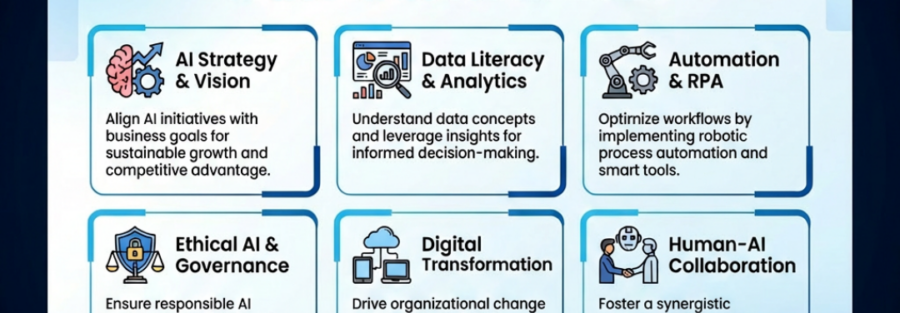
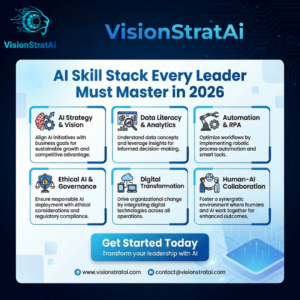
AI Skill Stack Every Leader Must Master in 2026
Introduction
As technology evolves rapidly, artificial intelligence (AI) is transforming the way businesses operate, innovate, and compete. By 2026, the competitive edge will belong not just to companies that adopt AI tools, but to leaders who understand how to integrate AI strategically into their organization. Leaders must develop a unique set of skills to manage AI, leverage data, drive ethical decision‑making, and foster collaboration between humans and machines.
In this article, we explore the essential AI skills that every leader needs to master in 2026 — skills that are not just technical, but strategic, ethical, and human‑centric.
1. AI Literacy & Strategic Fluency
Leaders must go beyond knowing what AI is — they must understand how it works and where it adds business value. This means recognizing the capabilities and limitations of AI models, learning how to apply them to real challenges, and being able to evaluate ROI before scaling any initiative.
Being strategically fluent in AI also helps leaders decide when to deploy AI agents, predictive models, or human insights most effectively mygreatlearning.
2. Data‑Driven Decision Intelligence
AI thrives on data — but without the ability to extract meaningful insights, data alone is useless. Leaders in 2026 must interpret complex datasets, transform analytics into actionable strategy, and guide decisions using real‑time insights from AI systems. This skill is often called “decision intelligence,” combining data literacy with strategic judgement mygreatlearning.
3. Human‑AI Collaboration Management
The future of work is not humans vs. AI — it’s humans with AI. Leaders must understand how to design workflows that integrate AI systems seamlessly, deciding what tasks should be automated, what requires human judgement, and how teams can collaborate effectively with intelligent agents mygreatlearning.
4. AI Governance & Ethical Leadership
As AI becomes more powerful, ethical risks — from bias and privacy issues to opaque decision‑making — grow with it. Leaders must be equipped to build frameworks that ensure AI systems are transparent, accountable, and aligned with organizational values and legal standards. This includes constructing responsible AI policies and overseeing compliance and fairness linkedin.
5. Change Management & Organizational Transformation
AI adoption succeeds or fails based on people. Leaders must manage organizational change, helping teams embrace AI tools while developing the culture, mindsets, and skills necessary for transformation. This includes continuous reskilling, communication strategies, and aligning AI goals with business priorities fourthrev.
6. Emotional Intelligence & Human Empathy
Despite advances in automation and analytics, human skills like empathy, communication, and trust building remain crucial. Leaders who demonstrate emotional intelligence foster stronger team dynamics, boost morale, and create environments where innovation thrives — skills that AI cannot replicate linkedin.
7. Data Stewardship & Responsible Data Practices
AI systems are only as good as the data they consume. Leaders must ensure data quality, security, and governance within their organizations. This means defining accountability, reducing bias, and ensuring that data practices align with ethical standards service-sens.
8. Continuous Learning & Adaptability
The pace of technological change demands that leaders keep learning. This skill involves staying updated on emerging AI developments, tools, and frameworks — and being ready to adapt strategies quickly to remain competitive in evolving markets linkedin.
9. Cybersecurity Awareness in AI Implementation
With AI integration come increased cyber risks. Leaders must understand the security dimensions of AI deployment — how to protect sensitive data, guard against bias exploitation, and secure AI agents from malicious influence — making cybersecurity a core leadership competency linkedin.
10. Strategic Foresight & Innovation Mindset
Beyond daily operations, leaders must use AI to anticipate market shifts, innovate new business models, and create long‑term strategies. This skill combines creativity, business acumen, and a deep understanding of AI’s potential across functions and industries forbesceos.
Conclusion
The AI era demands leaders who think strategically, act ethically, and collaborate intelligently with both human and machine partners. The AI skill stack for 2026 is not just about mastering tools — it’s about blending technical understanding with human insight, data literacy with ethical awareness, and organizational vision with execution capability.
Investing in these competencies will not only future‑proof leadership careers but also unlock sustainable growth and innovation in businesses across sectors.